UPDATE


Hi. This is an old, unmaintained blog. You may find these sites more to your liking:

Carson Brackney: This is my primary site.

Ad Astra Traffic: Content production/article writing service.

Ad Astra Traffic Team: For those who'd like to get writing gigs with Ad Astra.


Monday, July 31, 2006

Content supplier resorts to lousy marketing ploy...Blog spam escapes word verification...

After growing tired of all the lousy comment spam I was getting, I added word verification to the commenting process for this blog (see: Reluctantly creating a barrier to participation...). I really didn't like doing that, because I am all about maximum interaction and hate the idea of creating barriers (even small ones) to interaction.

It's a little hard to tell whether the change will actually dissuade any "legitimate" commenters, but it certainly has reduced the amount of comment spam. At approximately 4:40 a.m. (CDT), I received my first junk comment since making the change.

I am not that irritated about that comment worming its way into the Content Done Better Blog. I am obviously not a fan of comment spam, but it isn't like I spend my days pounding the desk until my fists bleed screaming about it. I tend to think of it as a sort of nasty fact of life, unfortunately.

What bugs me about the particular trash comment in question is its source: It came from another content industry competitor. In addition to the usual list of reasons why comment spam is rotten, here's why I find this particular case extra-annoying:

  • I believe in maintaining a professional, if not supportive, atmosphere between freelance content writers and content production services. Although we may be competiting against one another for jobs, we share many common goals and challenges and can benefit from one another's opinions and from working with one another. I don't like seeing someone within the industry willing to deface another service's blog, as doing so runs contrary to that perspective.
  • It's incredibly bad form. If the folks over at Dr. Pepper started spraypainting "Coca Cola Rules" on DP production facilities, we'd all probably agree that was in poor taste. Tagging the comment brick wall of a competitor's blog with one's own site info graffiti isn't that much different. C-spam is always an unattractive exercise in freeloading. Its ugliness is intensified when the perpetrator is hopping onto a peer/competitor's back.
  • It's lazy. Remember, word verification was ON. Someone, most likely, went through the hassle of reading and typing in the code to get comment access. If one is going through that much work, why not take a minute to read and respond to an actual post. That is especially true when both parties are working in the same industry and there is a pretty good opportunity of being able to add something of value to the conversation.
Please note, I am not talking about someone leaving a sig with URL after a legitimate comment. I don't mind people leaving a little signpost behind when they stop by to add to the conversation. I think that encourages legitimate participation and the exchange of ideas. I am talking about leaving a comment, with embedded links, just for the sake of getting those links in front of others...

I have decided not to delete the comment, which was made in response to this post. Instead, I am going to highlight it. I want to supply it in all of its glory for all to read.

Hey, if you want to spam the comments in hopes of snagging some business, you run the risk of being pulled out of the shadows and being put on display for all to see. I am sure the goal was to create a little positive mileage by non-responsively commenting here and there. The flipside of that is the risk of being announced as a C-spammer, right?

Here it is:

I found what I was looking for at some sites, but not all. That's why I built a site that would give you the Content that you were looking for. Content Resource Center offers everything related to original content that you are looking for.

I now leave it to the Content Done Better Blog readers (many of whom would have never noticed the comment otherwise) to make their own assessment of "Content Resource Center" based, at least in part, on their marketing strategy.

If the people at CRC would like to explain why they felt their post was something other than comment spam or would like to otherwise defend their marketing strategy, they can feel free to leave a (genuine) comment...

Technorati Tags:
, , , , , , ,


Del.icio.us Tags:
, , , , , , ,

Friday, July 28, 2006

Stopping the dribble...Good content's ability to reduce bounce rates...

You get a visitor to your site. He or she looks around. Then what? Does he or she stick around and do some reading, searching, thinking and buying? Or, is her or she searching for the fastest way to get the hell out of Dodge?

If visitors stays are brief, you have to find a way to make things stickier. You can spend on SERPs a million different ways and go into debt to get that high position at Google, but if that traffic jumps ship after seeing what you are offering, your investment has been squandered.

Visitors: Get them, keep them, sell them.

Today, I read a piece on this subject by Glenn Hefley, another freelance writer. He discusses bounce rate (the percentage of people who recoil in terror or who otherwise flee from your site in a matter of seconds) and argues that if a bounce rate is up around 30% or higher, there is a serious problem afoot.

I haven't crunched numbers on this, so I don't know if 30% is the magic point on the spectrum, but I do like what Glenn has to say about the whole thing. He's worth a read (see: "High Bounce off the Search Engine

I haven't crunched numbers, so I don't know if 30% is the magic point on the spectrum, but I do like what Glenn has to say about the whole thing and it is worth a read (see: "High Bounce off the Search Engine").

You see, webmasters come to freelance writers and demand keyword rich articles for the sake of SEO. They want better SERPs and loading up with material loaded with keywords can help. However, there should be some balance in terms of quality and keyword density. At some point, even the best SERP-promoting content in the world is a loser IF it's doing nothing to encourage staying around.

So, if you have a site and you are noticing high bounce, you need to make some adjustments.

Hefley has a nice list of factors ranging from bad links to poor site design that might be promoting bounce. Content, of course, makes it on the list in a few different ways.

My point?

First, bounce is bad. Your objective as a webmaster is to convert visitors into spenders. If they are hitting that left-pointing green arrow five seconds into their scan, you are wasting potential customers and erasing the value of your overall SEO investment.

Second, better content can reduce bounce. Time materials capture interest. Well-written text keeps people around. Truly informative articles get bookmarked. Good stuff gets return visitors. Strong copy captivates and removes wallets from back pockets. If the rest of your site looks okay, and your bounce is still high, content adjustments could be a great way to solve the problem.

Looking at bounce is just a good way to help people really see the value of quality content in action--and the costs of running with low-grade material. None of this is anything new. It's the same old story. Good content keeps people and converts them. Junk, even if it's gobbled up by Google and converted into good positioning, doesn't do the job once you get the visitor.

Create good content or hire someone (like me, perhaps?) to write it for you.

Technorati Tags:
, , , , , , ,


Thursday, July 27, 2006

THURSDAY SPECIAL: Seven part autoresponder series for next to nothing...

Research indicates that online buyers need multiple exposures to your product before making a purchase. That's one reason why a good site with sticky, tempting, and constantly-updated content is so important. It's also why a series of autmoated follow-up emails is a preferred tool of many successful internet marketers.

Do you have a product that could benefit from a seven-piece autoresponder series? If you do, this is a great offer.

I will produce seven autoresponder messages in support of your project. These won't just be seven mediocre solo ads. They will be informative, content-rich pieces that will entertain and inform while acting in aid of your product.

I've written dozens of these series for marketers, including some for very recognized industry names. They keep coming back for more because this strategy produces results.

You get a seven piece series. Each message will weigh in between 150 and 250 words (long enough to be meaningful, short enough not to be overwhelming).

You'll spend only $40.

I am taking two orders and closing the offer.

You can reserve your autoresponder series by emailing me at cdbrack@gmail.com, by using the form on the right sidebar of this blog, or by using the form on the main page of Content Done Better--whichever is easiest for you. Please don't try to reserve your slot using the comments section of this post.

I will edit this post when both slots are taken...

Wednesday, July 26, 2006

Mixed reaction re: writer flexibility...A few additional thoughts...

Yesterday, I wrote a post about the importance of hiring a freelance writer with specific topic area expertise and whether writers should be willing to "bite off" jobs when they lacked significant subject area experience (see: Choosing a writer based on topic expertise...)

I maintain that unless the client needs highly technical or nuanced material designed for presentation to an expert audience, that a well-researched writer should be more than capable of handling the job. I also believe that clients should recognize they don't need experts who write, but writers who can develop expertise.

That assessment has provoked some interesting reactions. Sean McKee commented that:

"I think this is encouraging counsel especially for writers (both the aspiring and professional kinds) who are looking to develop depth in their writing and, possibly, keep the work interesting and diverse. It is also encouraging to read an honest and responsive approach to crafting a sales pitch that, essentially, builds upon limited knowledge of a given subject (i.e., ignorance coupled with enthusiasm and ability)."

Although I wish Sean wouldn't have used the "I" word, I agree with his take. There is a level of skill development that comes from entering new fields. I've also found that work in a new niche invariably leads to new ideas and ways of thinking that transfer nicely to subsequent projects, even if the topics seem unrelated. Sean also hits a nail squarely by noting that both enthusiasm and ability (particulary in terms of research skills) are at the heart of why I take this perspective.

Speaking of enthusiasm, Wendy provided an interesting take on the subject. She said:

"This is something I'm passionate about, but with an opposite viewpoint than you Carson! LOL One of the most important reasons I began working for myself is that I hated being forced to do a job I had no interest in. If I was faced with having to research and write about the lifespan of clams, or how to improve your credit score, or which type of tile is best for bathrooms....zzzzzzzzzzzzzzz. I just don't think I could force myself through it. I'd feel like I was chained to my desk in an office again, mindlessly pushing keys on my keyboard in exchange for money."

Okay, first off I would like to say that I have tackled two of the three horrible examples she mentions over the course of the last year. No, really. I haven't done clams yet, but that could happen tomorrow.

I do understand her position--if she has no interest in the topic, the opportunity won't interest her at all. Originally, I approached this from the perspective of whether or not a buyer needs an expert. Wendy's comment is nifty because it reminds us that the stretch of expertise might need to be interesting to the writer, too. I usually don't run into that problem. I could credit infinite intellectual curiosity for my willingness to take on jobs that might bore others to tears. However, it probably has more to do with my distaste for turning down work. Honestly, though, I usually find something within every topic that interests me. The prospect of boredom has never really entered my mind when I decide whether or not to pursue/accept a job.

Diane emailed me and mentioned the post. She provides a different perspective on the subject:

"I was thinking about your post about being a generalist vs. specializing. I've always been sort of a jack of all trades, but to be honest, I don't get as much satisfaction from that as I would be an expert in just one or two areas. Obviously that can be limiting, but I feel like I spread my energies too thin otherwise. Though, learning about new things now and then is kinda fun. :)"

I think that is an interesting point. I guess I have never linked depth/breadth in terms of topic specialization to my personal satisfaction. Obviously, Diane has, and she comes out as an advocate of specialization. I guess my satisfaction stems more from the quality of work I provide and the continued growth of Content Done Better more than it does from topic areas about which I write. I can understand the attraction of developing a specialized field of topic expertise, though. In fact, I get called upon to do so much work in a couple of fields that I almost fear being labeled as the go-to person for materials on Topic Z. Guess I am just a generalist at heart.

Ann wrote a whole long post on the subject, which everyone should read. And, no, I am not just saying that because she said I am "truly an inspiration" and other nice stuff. Although that's not a bad thing to say, for those considering it.

In part, Ann said:

"I believe if you have good skills as a writer you can obtain jobs from clients even if you aren't the expert. If a client likes your work he/she may be willing to take a chance that you will deliver quality material and choose you over someone who may be more knowledgeable in the field. It's for this reason that writers should step out of their comfort zones, on occasion, and write about things they aren't familiar with.

Stepping into unfamiliar territory is good practice for the craft of writing too. Not only do you learn new subject matter but you also hone your skills as a writer. And in writing we are constantly working on and honing our skills. It's one profession that you must always strive to become better at. Even the well-known authors like King are constantly working on their skills."


I mentioned skills development when responding to Sean's observations, but I think Ann says it better. Removing ourselves from comfort zones and self-administering shocks to the system can be a great way of building up writing muscle. And I don't believe clients have to suffer as a result.

Tuesday, July 25, 2006

Choosing a writer based on topic expertise..."Willing to learn" vs. "need to know"...

This afternoon, I booked a job for a series of articles on a topic about which I frequently write. In fact, I have done similar work for the same client in the past. I don't know if I would consider myself among the world's top ten most knowledgeable people on the topic, but I know my way around the subject and do a pretty good job with it.

As an aside, the client mentioned another project with which he could use a hand on a wildly different topic. It's a topic that most people don't know a lot about and, to be frank, it's something most people would probably find rather dull. He wanted to know whether or not I had any ideas for him on where he could find someone who knew a great deal about Topic X, because he was going to need some content.

I don't know much about Topic X. I do understand the basic concepts surrounding it, however. I also know that I am a good researcher. I also know that I won't let a potentially dull subject matter keep me away (the horror story about 70 articles on Topic Y can wait for another day, but trust me...I will write on topics from which others might flee).

I wrote back and referenced his query re: Topic X. Here is the portion of the email addressing that matter:

"I am going to level with you about Topic X. ... I know my way around [the basic concepts], but I wouldn't claim to be anything close to a 'Topic X expert.'

That being said, I am going to give you a brief sales pitch... You don't need a Topic X expert to write for you. You could, however, use a writer who will learn about Topic X and present factually accurate information in a compelling manner. I can do that.

One of the most enjoyable aspects of my job is that I get to immerse myself in new topics and learn new things every day. It might seem strange to express an interest in learning about Topic X, but I am willing to do the homework and to produce the articles if you'd like.

I checked out the site and noticed you are running some [EDITED]. You're right--some fresh, unique material will probably help. If you'd like me to write it, I am ready to go. Let me know."

So, here is the big question... Am I right, or not?

I think I am. Well, I suppose that's obvious--I did say it, after all. Really, though, unless the topic is highly technical or requires a great deal of specialized expertise, I believe that a writer who has good research skills and is a quick study can do the job in most cases.

There are exceptions. As noted, if the titles need to focus on very precise things in a technical or nuanced way designed to appeal to other experts, you need someone familiar with the terrain to do the job right. I have turned down jobs on highly technical computer-related topics on multiple occasions because, although I could have researched the topics and written the articles, I didn't think I could deliver material that would be truly meaningful or helpful to an audience who lives and breathes those topics.

After looking over my client's site, however, I realized he didn't need scholarly work on Topic X from a learned expert. He needed solid, honest, well-written overviews of basic elements of Topic X. I don't know those (I'm starting to feel like singing some Same Cooke*) but I can learn them and write about them.

I see a lot of writers who specialize in a handful of topics. I think I would find that overlimiting. Although I certainly have areas of expertise that bring me a regular stream of clients, I enjoy the opportunity to tackle new issues and try not to lock myself into a "niche box." I consider myself a generalist, capable of handling most topics.

I know there are many people who disagree. That's why you can find extremely specialized writers. In the last few months I have covered...

Santa Claus and Santeria
Social Bookmarking and Social Security
Intaglios and Insecticides
The Cliffs of Moher and The Causes of Migraine Headaches

Along the way, I have done some interesting reading, learned a lot of great stuff and have written articles that keep getting thumbs up from my customers.

So, I obviously come down on the side of "willing to learn." Who believes that "need to know" is important for more general interest articles or materials that are not too highly technical? Also, who can tell me, as a writer, what they find particularly attractive or comfortable about limiting their work to a single genre? I'm not asking to start an argument... I really just want to hear some differing perspectives on all of this.

I'm off to take a few minutes to do some preliminary research on Topic X...


*Don't know much about history
Don't know much biology
Don't know much about science books
Don't know much about the french I took
But I do know that I love you
And I know that if you loved me too
What a wonderful world this would be...

Master plan destroyed...Choosing the right words...

Well, I had this great idea to write an ebook targeted at corporate CEO's. The planned title was "Revolutionary New Ways to Play to Win."

Then, this morning, I found this advertisement for "Words that Sell." It's a book designed to help copywriters choose their words for optimal effectiveness based upon target demographics. Lo and behold, the advertisement said:

"Copywriting is risky because words that you personally find appealing can have the exact opposite effect on your prospects. For example, you should never ever use the following words when copywriting to typical CEOs:

  • Revolutionary
  • New
  • Play to win"
YIKES! There goes Plan A. Fortunately, I still have that other project targeted at entrepreneurs. I just finished the sales page that has a headline about how my product is a "sophisticated means of creating growth and profitability." That'll get 'em!

Not according to "Words that Sell." Check it out:

"And, you'll definitely lose sales if you use these words in your copywriting to typical entrepreneurial leaders:
  • Growth
  • Profitability
  • Sophisticated"
Plan B is officially off the table, huh?

Okay, enough kidding around. Both Plan A and Plan B are fictional creations designed to illustrate the same point the folks who are offering "Words that Sell" are making. Our word choices trigger different reactions within different target audiences. Selling to streetwise hipsters is going to require different approaches than will peddling to the bald guys at the Board of Directors conference table.

I believe that attentiveness, experience, and research can usually help guide a freelance content writer toward the right word choices. A professional can find the right "voice" and isolate the beneficial triggers. I don't personally own a copy of "Words that Sell," but it's the kind of reading I do regularly and I may just have to order a copy.

I bring this all up because I think the importance of word choice extends past the realm of traditional copywriting and into "straight content" work, too. Every content job is designed to assist a client in reaching specific goals. As such, it's important for the writer to develop an understanding of the buyer's expectations and markets so that the right tone and voice can jump right out of the text. (see: Answering reservations about outsourcing content...lifelessness and Content writing as soft copywriting...Staying on the client's side)

So, if you are looking for content, spend a few moments advising your freelance writer re: your stylistic preferences. If you are a writer, take the initiative to crawl inside the heads of potential readers so that you can better connect with them.

Otherwise, you might as well just go back to Plan A. Or Plan B.

Monday, July 24, 2006

Reluctantly creating a barrier to participation... Comment spam spurs change...

I started this blog as a means of promoting Content Done Better and as a platform from which I could address issues relevant to the content industry. I also like the idea as a site for communication. As such, I decided to make it as easy as possible to comment on any of the posts here.

I believe in open communication and like to facilitate dialog when possible, so I decided against any sort of pre-publication moderation. I personally appreciate comment interfaces that allow me to add my $.02 and move on to whatever is next, so I opted not to use the blogger.com "captcha" feature, either.

I still won't be making anyone await my "thumbs up" before a comment hits the screen, but I will be forcing visitors to type in those annoying codes before commenting.

Although I am pleasantly surprised at the level of readership this blog gets, especially considering its reasonably narrow "target demographic," it really doesn't get a great deal of comments (see: "Your comments are appreciated..." where I lament this fact).

The comments I do get are usually great and some are even flattering, but there aren't a LOT of them. Thus, I figure the people posting comments here are part of a core readership who won't be dissuaded from participation by having to decipher and re-type "XALKDH" or whatever. I am also guessing that most of them will understand why I am doing this.

This blog receives approximately 3-5 spam comments daily. They get added to both old and new posts. They annoy me and they probably annoy readers who say, "hmmm, a comment, let me check that out" only to find an advertisement for someone's unrelated site.

I also have too much respect for anyone who is going to read this blog to subject them to a bunch of unrelated garbage.

Plus, if someone wants to advertise on this site, they can click on the Adbrite button on the sidebar and pay for the privilege, as far as I am concerned.

So, to those of you who do comment, please don't let the extra step dissuade you, and thanks for reading!

Why the long tail justifies content expenditures...Or, let a freelance content writer stretch your site's tail...

It used to be that I would tell clients, "The more content you have, the morel likely you are to generate search engine traffic from longer searches. Although you might be targeting one or two of the more popular keywords, more content will allow you to start collecting hits for longer search strings that aren't as common. Those add up and provide a great deal of residual value to the content."

Although those statements are true, coming from a freelance content writer, they have a tendency to sound a lot like "way #29 for this guy to sell his service." I could almost hear potential clients thinking, "Sure, if I have enough content I might get occasional hits for 'left-handed widgets for tired children in Monrovia,' but I want 'left-handed widgets' traffic. I can SELL to those people."

Since 2004, there's a growing discussion about this whole issue and what it really means in terms of site traffic. Fortunately, those involved in that discussion have started using a pithy name for the phenomena, the "long tail."

It's my belief that the current research and analysis on the long tail of search traffic is a great argument in favor of hiring a content writing pro.

Let's start at the beginning of all of this.

Wikipedia's discussion of the long tail provides a nice summary:

"The long tail is the colloquial name for a long-known feature of statistical distributions ... The feature is also known as "heavy tails", "power-law tails" or "Pareto tails". Such distributions resemble the accompanying graph.

In these distributions a high-frequency or high-amplitude population is followed by a low-frequency or low-amplitude population which gradually "tails off". In many cases the infrequent or low-amplitude events—the long tail, represented here by the yellow portion of the graph—can cumulatively outnumber or outweigh the initial portion of the graph, such that in aggregate they comprise the majority."

Chris Anderson from Wired has a great book about the long tail, and created a public diary about his tome that included a post called "The Long Tail of Design" that I think serves a as great place to develop an understanding of the whole thing. Anderson is sort of responding to an application of long tail theory by Domic Muren at IDFuel. It's a nice "1 minute primer of long tail thinking" for those who aren't familiar with the concept. Plus, there's a handy graph:


OK, so we have a body, representing the "mass market" and then a long trailing tail of smaller niches with correspondinly smaller populations. However, if you look at the graph, you'll notice that the long tail actually contains just as many, if not more, potential consumers than the body. Additionally, recognize that most sales efforts are concentrated on the body. Thus, the competition for the interest of the body is a helluva lot more intense than is the competition for various points along the long tail.

You can see where that's going, right? Niche marketing. Long tail theory, by that name or any other, has been one of the driving forces behind internet marketing for some time now. People in the IM community have been doing their market research in hopes of finding potentially lucrative smaller markets that can be mined for profits more efficiently than the massive area of the body.

Yes, Carson, running a series of "boutique sites" can be more profitable than trying to take on eBay or Wal-Mart.com. No kidding. What does this have to do with hiring a freelance content writer?

Good question. Here's the thing. Long tail theory can be applied to search engine results, too. If you take a popular keyword, log the searches made containing that keyword, and graph the results you are going to get something very similar to the graph above.

There is going to be a mass of searches just for the keyword and obvious 2-3 word phrases using the keyword. Then, you are going to have a precipitous decline in the amount of searches using other strings that will result in a long, flowing tail.

So, you can fight for that traffic in the body, but it's going to take some work. There's a lot of competition in the body. You can also start mining the long tail for traffic.

How? One of the best ways is content. And lots of it. If you hire me or some other freelance content writer to generate a series of pieces on "widgets," that content is assuredly going to produce strings containing the very kind of things for which those long tail searchers want. For instance, my article that contains the phrase, "...red widgets retain popularity among those in European nations..." you may very well find your site being tops in the SERPs for the phrase "popularity of European red widgets."

Here's an additional perk--even if you are not sold on the long tail idea, the content itself still helps with respect to marketing to the larger body. There is no forced compromise. Well-written content will serve both needs simultaneously.

An April entry at the SEOMoz.org blog notes:

"In the long tail of keyword searches, the great value comes from having hundreds or thousands of unique, valuable content pages written on a niche subject. The millions of completely unique search terms that hit the engines each day help to bring in traffic that a purely 'designed' strategy could never receive."

Blackbeard SEO
calls having a nice long tail the "hidden secret of blogging" and makes a strong argument for content as a means of long tail access with respect to blogs:

"So how do you hit the long tail for your site? Well, there are a few tricks that can help you, but realistically it’s simply a matter of how much content is on your site. The more you post to your blog the longer tail (keyword-wise) your site will have. Now, I’m not saying that you should post a bunch of crap posts to a blog, but a blog that has 1000 posts will have a much longer tail than a blog with 100 posts. That is why most blogs don’t make a whole lot of money for the first 6-12 months. It takes a lot of time to write enough content that a blog starts to have a really long tail."

NetBaldwin notes that constantly updated content regarding one's primary keywords and related topics is important to tapping into the long tail:
"To capture searchers through the Long Tail, a web site must include content that is consistently updated. And that content must go beyond the primary focus/purpose of the web site while also being (somehow) related."

Big deal, right? After all, those types of searches are few and far between. They don't represent a real traffic flow. That's true if you look at them individually, but as a group, they produce a great deal of traffic. And the more content you have, the greater likelihood you have of snagging good placement for many searches located within the long tail.

Stephan Spencer says that webmasters should "go after the long tail" and says:

"So, if you’re only targeting a handful of keywords, you’re missing the boat."

USWeb, the outfit behind Blogitive, states:

"Try to imagine the type of impact 1,000 targeted terms have on long tail. Suddenly your site is visible for all sorts of terms that you would have never thought of."

And to make matters even better, there's reason to believe these long tail searchers are actually more likely to buy than those targets within the body. These people are conducting more detailed searches than those who are just typing "widgets" into Google and cruising around...

If you run a website, you can certainly see the benefit of covering the long tail, especially if the best route of doing that ALSO assists efforts in the body, as well. The bulk of the search population--your potential visitors--are hanging out in the long tail. Using a freelance content writer to produce great content for your site can help bring them to you.

Thursday, July 20, 2006

Return of the ads...

Some of you may have noticed that advertising space in the upper right hand corner of this site has returned. When I started the Content Done Better Blog, it featured a few Amazon ads and some referral advertising through Google. I didn't run Adsense ads, though, as the prospect of advertising for other frelance content writers didn't excite me too much!

I then went completely ad-free for awhile. Now, I am trying something different. I signed up with AdBrite and am going to see about selling a few text link ads here. I am comfortable with that approach because I get full power to approve/disapprove of individual ads. This is not a contextual advertising option, ala Adsense (although that option is also available with Adbrite). Instead, a description of the blog is listed there and interested individual advertisers can opt to purchase the space.

Adbrite has a smart-pricing system for this... I set a minimum and as competition heats up for the few spaces available, the price will start to scoot upwards. Well, that's what will happen if people buy ads here, anyway.

So, you may be wondering how I got so desperate that I would approve "CHEAT AT POKER" ads, right? Well, I really haven't. What happened is that I accidentally checked the box allowing Adbrite to run network PPC ads in the space. I looked at the blog this morning and found that I was accidentally providing billboard space to the card-sharking industry... I have since changed my preferences and those should soon disappear with nothing else taking their spot until legit advertisers make an offer on the spot.

It's too early for me to tell whether this will be a good idea or a waste of energy for this particular blog. However, I can tell you that the Adbrite system has some definite potential. Selling those few text link ads can be a nice little income boost and if you are not using their contextual ad offering, it is apparently safe to run Adbrite and Adsense simultaneously.

If you have a blog and would like to try it out, or if you are interested in purchasing an ad here through Adbrite, just click on the button right above the links on the right side of this page.

THURSDAY SPECIAL: Return of the cheap press release...

I offered deeply discounted press releases as my first Thursday special. It was so well-received that I have decided to do it again...I am crazy, but I am not crazy enough to do them as cheaply as last time... Close, though. The price is slightly higher this time around because (a) I think those who jumped in on the very first offer deserve a little extra love and (b) I am only writing three of them this time...

The first three people to take advantage of this offer will receive a press release to help them in their promotional and public relations endeavors. The custom-written full release will come with all the usual Content Done Better guarantees.

The price tag: Only $33.

So, if you have been considering commissioning a press release but have been looking for a great deal, this is the perfect opportunity. If you haven't really been thinking about a press release, this might be a good time to do so.

Note: If you have any doubts as to the potential value of this offer, please READ THIS.

The offer is valid only for the first three people to respond to this Thursday special. Limit one press release per individual. Turnaround time will be within one week from receiving the necessary information to proceed (don't worry, I will tell you what I need from you to write a winner).

You can reserve your $33 press release by emailing me at cdbrack@gmail.com, by using the form on the right sidebar of this blog, or by using the form on the main page of Content Done Better--whichever is easiest for you. Please don't try to reserve your slot using the comments section of this post.

I will edit this post when the third slot is taken...

Wednesday, July 19, 2006

Taking control of the industry, Part Two: Removing the rot and reaping the rewards...

This is Part Two...

Another reason why freelancers are dealing with lower rates is because of bad apples that have tainted our collective barrel. Plagiarists, scrapers, those who "took the money and ran" and other less-than-stellar freelance content writers tend to depress prices for legitimate providers. You might think that in a sea of nefarious sharks the honest dealers would be more likely to prosper. However, the perception of freelance content writers is marginalized to the point where establishing trust in the industry is complicated.

What do those of us on the good side of the ethical divide do? Unfortunately, not very much. We tend not to be vocal in our criticisms of cheating writers. We tend to overlook some of the mindsets and circumstances that continue to coax the bugs out from under their rocks. We don't do enough to differentiate ourselves from the bad guys,

Every day that freelance writers plod along without trying to take a stand against those who contribute only decay to the industry are focusing on completion of that next project to the detriment of providing themselves with long term stability.

All freelance content writers should consider making it a point to take a zero-tolerance stance against those whose actions give customers cause for concern. We should be willing to maintain an uncompromising position and to be honest in our assessments when we see things being done "the wrong way."

We should also focus on explaining the value of professional service and quality to the marketplace and reject claims that being a quality writer requires nothing more than a keyboard and few idle hours. The people enticed by these claims invariably turn out to disappoint their few customers and harm the industry.

Those writers who are serious about their work should make a point of differentiating themselves from the low-quality providers. Demanding more money has long been touted as one way of doing that, but market limitations make the efficacy of that strategy questionable unless it is simultaneously buttressed by other efforts demonstrating professionalism and quality.

Every day, I read complaints from writers who are insulted by low offers. They believe that they receive too little respect and are unappreciated. They feel trapped in a global economy that may prefer half-cent per word gambles over those of the nickel variety.

Part of the problem is the supply/demand imbalance that has forced all of us to be as lean and competitive as possible. I am sometimes considered an apologist for low rates because I am willing and able to take jobs that others wouldn't touch. I don't think I am... I tend to believe that I am trying to remain competitive while offering rates that make sense to my prospective clients.

However, one of the reasons those rates have to be a bit lower than even I would like sometimes is because of concerns that are not so much related to supply and demand as they are to quality and honesty. Based on my experience, webmasters will pay more for content when they know their writer is reliable, honest and produces quality. Those who are unwilling to extend a penny per word are as likely to be past burn victims as cheapskates. After a few unsuccessful and disappointing rounds in the freelance content ring, they are convinced the fights are rigged against them. They may be willing to gamble on the cheap, but a serious investment just doesn't make sense based on their experiences.

By taking actions to clean up the freelance content biz, writers can make things better for themselves and their clients.

Taking control of the industry, Part One: Freelance content writers can use self-promotion to counteract depressed rates...

The question of pricing for freelance content work is always controversial. If you attack low-paying jobs, someone like me with an affinity for the marketplace to sort out pricing will jump on your back. If you support acceptance of lower per word rates, a slew of writers will attack you as if you are trying to rip the last scraps of food from their plate.

I don't need to have those arguments again. Not today, anyway. We can save them for some other time when I can muster enough righteous indignation and motivation to go over the same old talking points again. Instead, I want to talk about how writers themselves may be responsible for their perceived lack of pay.

By that, I am NOT referring to their willingness to take jobs at market rates. I want to look at things from a different perspective. I have noticed a few things that I believe influence those market prices for freelance writers that individual freelancers can do something about. I have divided those thoughts into two categories and have decided to address them as separate posts. Consider this Part One...

Intermediaries reduce pay rates. If you are booking jobs through a third party, you are missing out on the opportunity to make more money. The person who has set up a writing service where they market content and then subcontract it out to individual freelancers is trying to pay the bills. He or she is taking a cut right off the top. In some cases, that cut can be substantial. In other situations, the percentage is marginal.

I don't think that's unfair, by the way. The person who is finding clients, delegating jobs, accepting risk, etc. deserves to make a living. I will personally accept jobs through "article brokers" to fill my schedule. I also occasionally wear that hat myself, lining up writing talent for clients' jobs I cannot personally complete as a solo act. I try to take a fair cut and don't use those instances to generate huge profits, but after managing some of those projects, I can tell you that the effort is significant.

However, if I had my choice, I would always line up my work personally. I'd prefer to bypass the guy or gal in the middle completely and negotiate my rates directly with the person in need of written material. That way, I know that I am securing the best possible rates for my work.

Of course, the time and effort involved in marketing and cutting deals must be considered as part of the "profitability" equation. If successful marketing required an amount of time that rendered the higher rates neglible because I was spending all my time looking for buyers, it wouldn't make sense to go that direction. However, I find it relatively easy to sell my services and the rate increase over working with intermediaries makes spending some time pounding the virtual pavement a financial winner.

So, if you are a freelance writer and are depending, in large measure, on article brokerages or third-party intermediaries as a work source, you might be contributing to your own struggles. If you can find a way to go direct instead, your earnings could be substantially higher.

Doing this, however, requires a willingness to invest your own "sweat equity." You have to learn how to sell your writing and to whom it can be sold. There is a learning curve and (in the short run) self-promotion may cost you. In a field where it seems like many are always chasing the next fast cash payout, there may not be enough writers willing to learn how to promote themselves or to invest time, energy and even money into doing so.

In the meantime, the marketers snag the leads and outsource the work cheaper. I think the decision to learn how to successfully pitch yourself as a freelance content writer makes a lot of sense...

Thursday, July 13, 2006

Stalled but not forgotten...Three things I have been meaning to do and eventually will...

I've been really busy lately.
There are a few things I have mentioned here in terms of future plans and I wanted to provide a quick update on them. I'd love to have them all done, but paying clients always get priority, you know.

Duplicate Content Ebook: I have completed research and started writing an ebook on duplicate content filters/penalties. It's my goal to provide a quality resource that can help people better understand what the terms really mean, how Google notices and handles duplicate content, etc. As soon as it is done, it will be offered (briefly) to Content Done Better Blog readers either for free or at a greatly reduced price. I will announce when it is getting close to completion.

Associated Content Research: I get upset with myself every day over this one. Those of you who submitted data for use in the AC research project are probably wondering what happened to it. Well, it was carefully placed in a database for manipulation and examination. Then, I wrote over the file and lost it like an idiot. Hey, give me a break! I am a writer, not a number-cruncher. I am going to cull the data (in its various forms) from your emails and will then get the database put together along with some preliminary conclusions.

Writers Cooperative: I will be honest with you, I am not sure where this is right now. The original vision approximating a joint site for interested freelance content writers was compromised out of necessity to more of a "mall of writers" plan where members would receive template-driven webspace to hawk their services. Diane Penna, who I know is just as busy as anyone else, was working with some organizational and design options. Eventually, we need to decide in which direction to take the project.

Okay, those are the three things I want to get done that I haven't finished. Just thought some of you might want to know what's up.

Now, back to client work. Well, I might try to solve the linkie winkie mystery. For those of you who haven't heard, linkie winkie is an ostensibly friendly little site that seems to be helping people find more visitors to their sites. If you happened to come here via linkie winkie, thanks for stopping by and feel free to look around. If you need a content writer, remember Content Done Better. Good to know altruism isn't dead, even if it is part of a social experiment...

THURSDAY SPECIAL: Blogger for hire at a low, low price...OFFER CLOSED

SORRY, THIS OFFER IS NOW CLOSED! CHECK BACK NEXT THURSDAY FOR ANOTHER CDB SPECIAL!

So far this month, Content Done Better has agreed to terms with two clients who needed well-written, consistently maintained themed blogs on a continuing basis.

I want to use the Thursday Special to make it three.

Here's what you get:

  • 5 "Starter" blog posts to add some immediate "heft" to the blog.
  • 2 New posts per week for ten weeks (20 total posts) with an option to continue the service at the conclusion of the special offer at a mutually agreed upon rate.
  • Hands-off operation. Content Done Better won't just handle the writing, the posting will be done for you, too. (If you'd prefer not to extend administrative access, you can do the posting yourself, of course)
  • Quality posts. The blog will address timely issues and important matters related to your theme in a way consistent with your desired message. Each post will average between 200 and 400 words.
  • Expertise. I operatehigh-earning Adsense blogs, this blog and have worked on many other successful blogs. I have written a well-received ebook on the topic of blog traffic generation and understand how to best use the written word to help your blog succeed.
  • Control and direction. If you have specific topics, needs or requests they will be met to your specifications. Posts can be submitted for editorial approval prior to posting, if so desired.

Total cost: Only $175. That is less than 2.5 cents per word and includes posting.

Hey, everyone knows that blogs are a spectacular way to snag traffic and build a presence. If you aren't blogging, you are missing out.

This offer is available to only ONE buyer. After one person locks down this deal, it's over.

You can contact me via email at cdbrack@gmail.com. Alternatively, you can use the contact form at Content Done Better, or the form on the right sidebar of this blog.

Wednesday, July 12, 2006

A great way to start... Cool tool...

This might be old news for some people, but I just learned about it today. It's a free service called Protopage and I am in love with it.

Protopage allows you to create a personalized start up page featuring whatever items you'd like. You can add your email in-box, your favorite RSS feeds, your preferred search engine search boxes, links, and more. Even custom-colored sticky notes, which can be very handy. The display is flexible and customizable.

This AJAX-driven freebie is a lot of fun and is a great way to organize and have all of the stuff you really need to look at regularly right at your fingertips. I've also noticed more than a few Protopage hacks floating around out there that could serve to increase its utility even more.

I usually stick to content writing and copywriting issues, so you might be wondering what led to this ringing endorsement. Well, this blog post is certainly not paid advertising, if that's what you are wondering. It's just a heads-up on something I think has great potential and appeal for both my clients and fellow writers.

Content Done Better originality guarantee gets nod...

Regular Content Done Better Blog readers are probably familiar with Plagiarism Today (or at least with my appreciation for the site). It has a spot in my blogroll and has been the source of some interesting material and insight regarding content misappropriation issues.

Though I have never met Johnathan Bailey, the guy behind Plagiarism Today, we have corresponded occasionally and have commented on one another's sites. I hope that interaction doesn't make anyone think that his positive commentary on the Content Done Better originality guarantee is somehow biased or was issued "upon request."

At the risk of blowing my own horn a little too loudly, I invite my readers to check out The Promise of Originality at JB's site. He seems to agree with me that originality guarantees on the part of writers, combined with more concern on the part of webmasters, is one tool for fighting plagiarism that can make a difference.

An excerpt from Plagiarism Today:

"According to Brackney, more content writers need to offer a similar guarantee and content purchasers, when looking to acquire new works, need to demand one. It may not completely stop plagiarism in the content writing industry, but it will at least provide safeguards and protections."

Tuesday, July 11, 2006

Good "timings" is everything...A rant...

The site is ostensibly about parenting in India. It covers everything from internet safety for kids to easily recited Shlokas (which are prayers to specific Indian deities, according to the site). For some reason, however, it contains an article (there's no link to this that I can find anywhere on the site) entitled "Freelance Writing Jobs." The page has a bit of Adsense, but no other apparent justification for existence on the site.

That's odd, perhaps, but certainly not unprecedented. The site owner wants to try to score a few Google nickels with an article about freelance writing. So be it. Interestingly, the article appears to have been written by (or for) the site owner. The author's name and a copyright notice are affixed to it. I don't find it published elsewhere around the web.

So, why does this warrant a post here? It's just another article about freelance writing, floating around out in cyberspace in hopes of inducing a few ad clicks, after all. Well, the actual content of the article rubbed me the wrong way. Let me show you. Here's an excerpt:

"But did you know that Freelance writing could be done by almost anyone. It does not require any set of so called specialized skills in writing. The word writing is in this case highly misleading. It conjures up in the unsuspecting innocent mind images of serious writers poring over pages in a trancelike state scribbling away in an inspired moment. But freelance writing is simply like making conversation to a friend, only also penning it down and sending it to someone who can use it. It is yet another tool of marketing used by the people who will pay you for the writing.

In a career as a freelance writer, one can find a lot of flexibility in terms of timings and also the place of work. You could be anywhere and doing anything else and yet make money with a freelancing job.

...train your amateur eye to focus on opportunities on Freelance writing. This is where the stable and guaranteed money is."

Apparently, freelance content writing is a great source of "stable and guaranteed money" that "could be done by almost anyone," even those who are not "serious" and merely strive to write down something akin to a "coversation to a friend." It also offers great flexibility in terms of "timings."

All I can say (well, all I can say without dipping into the profanity bucket, anyway) is "wow."

Every time I take on a writing job I approach it professionally. I bring my college and graduate education to work with me. I bring the experience of countless hours wearing out keyboards and trying to match client needs with me. I tote along decades of work experience in a variety of professional fields other than freelance writing. I work on every Content Done Better project with my customer and his or her specific needs in mind. I take pride in offering a quality product. I back my efforts with a tight guarantee policy. I don't approach my writing with the cavalier attitude I might have when discussing a ballgame or dinner plans with a friend.

However, this individual seems to think that just about anyone with some basic command of language and internet access can do the job just fine. Hey, anyone can generate a stable income without having to know a damned thing and without having to be a skilled and serious professional!

Of course, the article is crap. That's obvious. The litany of errors in the piece flag it as a piece of junk. I am prone to occasional blog typos and errors of haste, so I don't like to mock or dissect others' errors. After reading this piece of anti-wisdom, however, I went ahead and put "timings" right in the post title.

Sure, I am offended by the article. It's not altogether unlike an electrician reading that "anyone with a Home Depot charge card can wire a house without being serious" or a brain surgeon reading that "performing brain surgery is no harder than chopping lunch meat and the earnings are great!"

The article is an insult to anyone who writes for a living.

Even more annoying, however, is the fact that "advice" like this floats about in a variety of places, polluting the writing waters.

It's true. You don't have to be Marcel Proust to write content. It's true. You don't have to resemble the long-held stereotype of the beard-stroking, fountain pen-toting "writer" to do the job. However, to maintain that anyone can write effectively is an outright lie. Articles like this encourage the underskilled to bite off projects they cannot chew. They're the reason people shop rewrite projects to me every day. They're the reason so many oft-burned webmasters begin to seek out alternatives to hired content.

You see, not everyone sees through the crap. Some underskilled person will read that article, create an Elance account and book work he or she cannot handle. Some poorly informed webmaster will read something like that and will question whether or not they need to deal with a real professional. An erudite webmaster will read something like that and be sickened by the quality and attitude and might just swear off freelancers altogether, believing that any one of them could be a not-so-serious wordsmith hoping to make a good living with flexible "timings."

If you can't resist reading the original article, it can be found here.

P.S. I'd like to be clear that although the article came from an Indian site I am NOT implying that this is an Indian problem. There are those in the freelance writing community who would like to demonize Indian writers, who they perceive as being a cause for lower rates. That's a different debate (and you can see what I think about that here). There are plenty of American, British and North American people who are spreading the same bunk about writing for the web (I mentioned one less egregious case here).

Dogs and worms bring Content Done Better Blog out of temporary hibernation...

I have been skipping the daily blog post in an effort to recover from vacation and to beat down a growing pile of work.

However, I found something today that compelled me to post. I keep an eye out for others who have mentioned me or my work online. I imagine most freelance writers do the same thing with respect to their businesses.

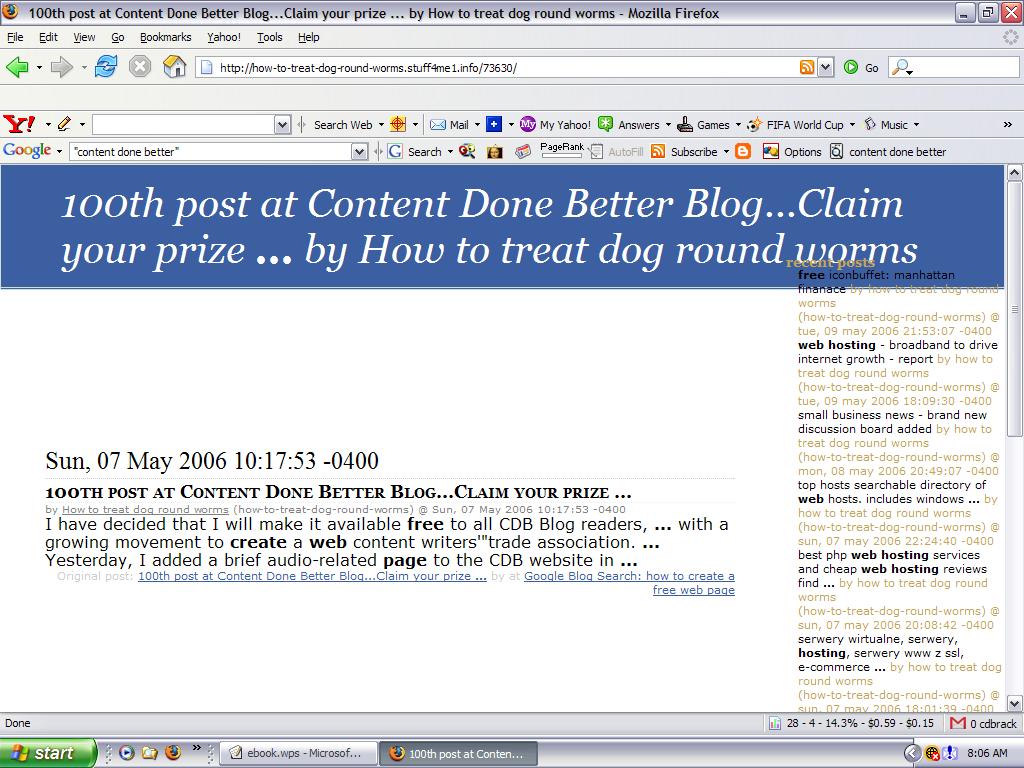
The photo accompanying this post is of a page that mentions Content Done Better. More particularly, it is a little scraper site that decided to steal one of my blog posts for use as keyword rich content. You should be able to click on it to see it in all of its full-sized glory.

I am completely opposed to this kind of content misappropriation, and to lousy sites of that sort. However, my distaste for their nefarious activities is secondary to the fact that my post ended up being stolen for use on a site ostensibly dedicated to "How to treat dog round worms."

I'd probably be p*ssed off if it wasn't so funny. Somehow, my 100th post here has become fodder for a Google gamer site dedicated to round worms.

If the photo isn't enough for you, check out the site (while it lasts) here.

Oh, and here is my original post that was "excerpted" on that fine site. At least they linked back, I suppose.

Thursday, July 06, 2006

Freelance writing job boards... Same job, different board...

Awhile back, I commented on my general distaste for freelance content job boards. Basically, I found the amount of effort necessary to successfully utilize the boards was too great considering the reward and that pursuing other marketing efforts made more sense to me. I also found that using these boards from the other side of the table (as a buyer) was a giant pain in the neck and felt that might have an impact on the value of these sites.

A forum discussion about the boards recently caught my eye and I thought I would take a few minutes to revisit the topic.

Some involved in the conversation argued that they were quite valuable. They noted that it is possible to secure reasonably-paying freelance writing jobs and that they had secured many repeat clients that grew out of board jobs.

Others maintain that the listed jobs offer substandard pay overall and that the same jobs appear on a number of sites, dilluting the value of any one particular board.

I can't really speak to the rate question as it stands today. I abandoned use of the job boards in favor of other alternatives some time ago and don't have any firsthand knowledge about what people are making, in general, from those opportunities. I do know that when I sought work via the boards that they did tend to be a little less lucrative than other jobs and that there were some that were certainly rated for an economy unlike my own, but that is no big surprise.

The fact that many buyers are posting the same jobs on multiple boards, however, made me think...

I recalled my experience as a buyer and the avalanche of responses I received for a relatively small job. Making a valid choice based on quality was virtually impossible simply due to the massive response. I can only imagine how annoying it would be to cull through a series of sites in pursuit of a freelance writer! It would be insanely inefficient.

Who would go through that kind of hassle? Unless it was for a huge, critical job, I would guess that those multi-site posters are probably not as focused on quality as they are on price tags. It's easy to "leaf through" seven hundred bidders to find the lowest rate. Actually looking at what each one has to offer, however, is a chore. If you multiply that chore over five or six boards... Well, forget about it.

I think it's probably safe to say that anyone shopping a smaller project over multiple sites is out searching for the right price tag, more than they are the right writer or overall package. I don't ncessarily begrudge them for that. There are certain online business models where quality takes a backseat to quantity, whether we like it or not.

I could be wrong, but I just cannot imagine anyone shopping a small project taking the time and energy required to plow through the resulting mess.

Tuesday, July 04, 2006

Happy Independence Day to all...

The "blog about the 4th" momentum is too strong for me to resist. I have to play along, too.

I work with people from all around the world. Americans, Canadians, Brazilians, Indians, Malaysians, Thais, Fillipinos, Irish, Australians, New Zealanders, Spaniards, Pakistanis, Romanians, South Africans and others. I even work with a few folks from England--our avowed enemy back in '76. My world is international and borders don't always register with me the way they do with other people.

It's hard for me to think about a holiday in terms of "my country" when I have sort of recalibrated myself to think about "my world."

I do love America. It's my home. I love much of what goes on here. There are also parts of the "American experience" I don't like. There are many policies enacted in my name as part of the United States of America that I don't like. Nonetheless, I love America. Particularly, I love its potential.

That's really the one thing we have going for us. Potential. We have stumbled (apologies, founding fathers if that verb choice accords you too little respect) upon a system of government that is open-ended. There is room for flexibility, adjustment and advancement. Nothing is "set in stone." Yes, we have some bedrock principles underlying our historical governing documents, but their beauty is the way they embrace an ability to change.

So, today I am going to celebrate America's potential. Instead of resting upon laurels and celebrating its successes or being overly critical and spending the day attacking its weaknesses, I am going to appreciate the potential of the United States of America.

Interestingly, that is something everyone can do. Regardless of your political leanings or desired outcomes, each and every American can find common ground in terms of the potential we have as a nation. How is that for avoiding the divisive politics that tend to pollute the civic waters?

Celebrating potential is a fitting tribute to those who signed off on the Declaration. After all, that document didn't actually do much on Day One. It didn't win a war or establish a nation. It made a statement. It said we aren't going to tolerate limits. We won't abide by tyranny. We won't answer to arbitrary authority.

That's a sanitized reading off the document; a positive interpretation that strips away some of the economic motivations and doesn't dwell on some of the not-very-flattering comments about native Americans ("the merciless Indian Savages, whose known rule of warfare, is an undistinguished destruction of all ages, sexes and conditions...") but for today's purposes we will focus on the positive.

We have a pretty cool country here in the U.S.A. It certainly isn't perfect and there is plenty of room for improvement, but the great thing is that we have the opportunity to fix it if we can combine sense, will and smarts.

Have a happy Fourth of July. If you are a U.S. citizen, try not to blow off your hand while lighting that M-80 with the barbecue grill.

Saturday, July 01, 2006

Article marketing IS a good idea...

Those of you who've been reading the Content Done Better blog for awhile might remember a series of posts and comments on the always controversial topic of pay rates. I provided my perspective on the issue after reading an article about so-called "cheeseball bottom feeders" by a freelance writer named Star Lawrence. Let's just say we didn't agree on things...

I read another Star Lawrence article this afternoon. "Want Tens of Thousands of Content-Hungry Publishers Feeding on You?" argues that sites like EzineArticles.com fail to compensate authors for their work and that she doesn't "think giving my content away to the type of people who would take free content from writers is going to help me."

Lawrence perceives non-paying article repositories as a form of writer exploitation and just doesn't believe that she should be handing over her work for "free."

The concept of article marketing is so ingrained within my noggin that I was completely amazed by her stance. After a few seconds of head scratching, I came to grips with the whole thing. Lawrence sees it as writing for free. Marketers understand it as getting value in trade for the content.

You don't get cash for your article, but you do get a nice collection of perks. It's a great viral method for backlink development and can boost SERPs. Those backlinks are extra tasty because they don't require any reciprocation on the part of the submitter. There's also some branding value and (usually) some nice pre-qualified traffic flow from the bio box link. There's a long discussion of the value of article marketing and associated article sites at the EzineArticles Blog. Folks there go after Lawrence the way she might take on a "cheeseball."

If you consider the value "free" article distribution produces, it generally swamps the going rate for the article in the first place. That's why clients hire me to ghostwrite articles for distribution. Not only are they not getting paid cash for the article, they are paying me to write it!

I didn't bring this whole issue up just to renew the mini-feud with Star Lawrence. I thought it was a good opportunity to inform people about hiring a freelance content writer for article marketing purposes.

I also think the article is a good reminder to freelancers. You never want to forget to explain the value of the service along with the quality and nature of your work to prospective clients as part of promotion and marketing. Lawrence is a veteran writer who undoubtedly has a wealth of experience and knowledge of her craft, yet she doesn't seem to be "plugged in" with respect to article marketing. How many potential clients are in the same boat? Probably quite a few.