Cold...
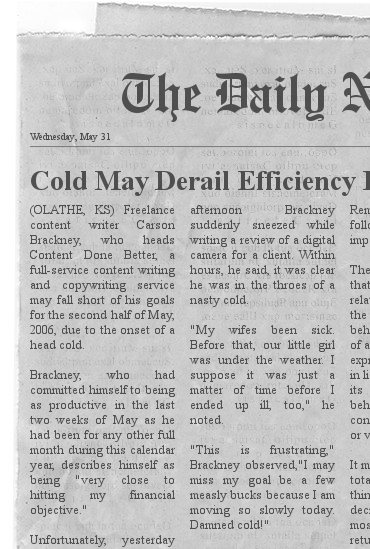

 I was reading the Newfangled Web Factory site this afternoon. Newfangled is a web design firm who appears to enjoy working from a WebTop CMS platform. They have some interesting things to say about written content, the impact of CMS on written content, etc.
Anyway, this grabbed me:
"First, the marketing paradigm for using visual impact is inverted on the web. I've written about this dynamic many times over the years, but it merits reiteration. Offline, image and visual impact is necessary in order to grab attention. You must win attention before you have the opportunity to say anything. In these situations, visuals often trump words. Some of the best ad campaigns have little or no words in them at all. Where brand reinforcement is the objective, an image of an athlete with a "swoosh" can do the job nicely. However, on the web there is literally no "stop and grab attention" work to be done at all. People don't walk past websites or have websites presented to them in between television shows. They choose to go to a website based on an interest of some kind. They type in a URL, choose a bookmark or click on a link. The design of the site has no role whatsoever in their choosing to click on a link. This is not to say that design and images are unimportant; once they do click, site's looks fills the same important role it does in a brochure, annual report or billboard. But the initial attention-grabbing part of the equation is removed.
Another reason for the elevated priority of words on the web is the expectation of why people go to a website. Except for a very small percentage of ubiquitous brand sites like Coke, McDonald's or Nike, or sites where the purpose is highly entertainment-oriented, most websites get traffic from people in search of information. Such information may very well include pictures, like maps on MapQuest, but usually the information is contained in the words of the site."
I think freelance content writers have a tendency to undersell their product relative to other site elements and the Newfangled comment does a good job of explaining why the written word is uniquely important to online business. It explains why the very nature of net use makes words particularly valuable even in comparison to graphical elements, which are often perceived as the "star of the show."
Most freelance content writers will tell potential customers all about the value of great text, but rarely are they willing to position their product as a competitor for other elements. That unwillingness to sell writing over graphics, for instance, may be uncomfortable for those writers who aren't particularly familiar with the matter or confident in supporting the claim.
Some of that may be a byproduct of habit, too. I think that's the case with me. I don't often advise prospective clients, for instance, to spend more on me and less on graphics. I can't say that I am in the habit of telling a prospective client unable to afford a content job that a de-emphasis on graphics would allow him or her to afford the text they really needed. However, there is a natural competition within the budget and it may be wise to raise that issue.
Ideally, of course, there's enough to go around for everyone and the writers can join hands with the graphics people and sing a happy song. But when there's not... Well... Well, loyal readers noted that controversy produces readers and comments. So, why not be a little controversial today? Or, at the very least, argumentative... The most commented upon series of posts here was the infamous "cheeseball bottom feeders" exchange. It had seemed like that debate had died down. But this morning, I noticed this at a freelancer's forum in response to an ad offering content writing projects at a rate less than two cents per word:
"...they want their writers to work around the clock and never miss a deadline for chump change. The state of Internet writing is absolutely ridiculous, and the problem is getting worse and worse. If you are serious about writing, it is time to make a stand against these a**holes [edit mine] and the people that support them in any way by speaking up and refusing the work. If they go to the Indian companies, they will suffer in their content anyway."
Because I can't resist...
(1) It isn't necessary chump change. I don't have the energy to do the math for everyone again or to explain that it might not be a good plan for everyone, but it is possible to make lower paying markets lucrative. It requires the right writer and the right circumstances, but it does happen with some regularity.
(2) The "problem" isn't a problem for anyone other than those who are whiny. It's simply a reflection of market forces. I can just imagine a guy who wants to sell Charmin for $20 a roll yelling about how the "problem" is that the toilet paper industry hasn't organized to demand more. We'd laugh. Why? Because we have an idea of what toilet paper is worth, what competition is, how supply & demand work, etc.
(3) A massive freelancer "walkout" to force rate increases? Imagine herding cats. Then, imagine herding cats who have taken a megadose of cocaine. Now, imagine herding those coke-fueled cats in the dark of night. Oh, and remember, some of those cats already understand the first point and have an active interest in not being herded at all.
(4) The prospect of information consumers really caring how much freelance writers make is laughable. Do you ever read your morning paper and say to yourself, "I sure hope the staff writer covering the city council is making enough?" Have you ever felt really worried about how much the copywriter who came up with that slogan on the new billboard is doing financially? Have you ever looked for a movie review online and thought, "I sure hope that person was paid at least a dime per word?" Didn't think so.
(5) Quality is only part of the equation. As much as we love quality content as writers (and it is a good thing for many reasons), webmasters buy text in order to produce a profit. Thus, the bottom line is what really matters. If U.S. writers somehow organized and demanded more, the question on buyers' minds would be, "Is a possible quality shortfall combined with lower prices like to produce a greater profit than better content at a higher price?" The answer to that question may not fall on the whiny writer's side.
(6) Don't be too dismissive of India. It's home to some talented writers. Yes, there are many subpar wordsmiths from the subcontinent, but it is a mistake for U.S. writers to treat non-U.S. providers as if they are a second rate across the board. When you take your competition lightly, you can find yourself in trouble later.
Your daily dose of trouble-making controversy. Thanks for reading!
 I know how many people read this blog every day and I know how many comments it receives (excluding the "I read your blog and thought your readers would be interested in buying Viagra" comment spam).
I have noticed a huge disconnect between those two numbers. Admittedly, I don't comment on every blog I read, I do tend to leave remarks with some regularity. I am interested in hearing from others who operate blogs in this field about the regularity with which they receive comments and if they have stumbled upon any way to increase interactivity levels.
This blog is a marketing/branding tool for Content Done Better. Hopefully, it is a relatively interesting source of perspective on the freelance content writing and copywriting industry, too. Even if I never received a comment on any post, I would keep plugging along with it. However, I would like to see it serve as something of a "conversation starter," too.
So, if you read and don't comment... Well, start. If you have some sage advice about increasing participation or any observations regarding why this blog may not be producing comments, let 'er rip. If you have found good ways of increasing participation at your blog, feel free to share.
Part of me wonders if the massive increase in blogs has led to a comment drought for non-A-listers. There's more to read out there and everyone is also writing their own blog... Maybe it's just the nature of the beast?
Anyway, I look forward to your comments on the subject. Let's see if there are any!
 May will soon be gone. I issued myself a challenge for the 2nd half of the month: to be more productive than I had been in any previous full month. Many of you joined in, either duplicating that goal or creating one of your own.
I thought I would take a moment to provide an update... I think it's going to work out! With the clock ticking faster and faster, I am in a little bit of a race to meet my objective, but it looks very possible. I think this has worked better than a New Year's resolution for a few reasons:
First, I believe that putting a "deadline" on the plan inspired me to get things done. Often, we lay out big goals that are open-ended. Setting a precise time-frame for action seems to force one to get things done. Writers are accustomed to deadlines, so the idea of imposing one on a professional objective seems to make a lot of sense.
Second, I believe that sharing the plan helped. There is something about telling others what you will be doing that creates a sense of accountability. Although my objective was a personal one, sharing it helped inspire me to action.
Third, knowing that others were joining this little crusade did provide some impetus to get the job done--and added a fun dimension to the process. On some level doing that creates a sense of comraderie and inspires. Plus, of course, misery does love company!
In a few days, I will break down what I learned during this whole process in terms of increasing efficiency and polishing work habits. I'll be interested to hear updates from other writers, too, and to find out what kind of wisdom they can impart after involving themselves with this two week sprint.
 This morning, I heard a radio report on NPR about Williams, Arizona, and a band of high school kids there who play together in the style of a Civil War band. The band's director, in his interview, mentioned a particular battle that he felt highlighted the role of musicians during the war. It was an interesting tale, and it led me to do a little more research on the subject this morning.
After reading more about the matter, I decided the underlying message was probably more important than the interview indicated. If you are here in the United States (and my stats indicate that approximately 80% of you are), take a moment to memorialize the young men with horns and drums at the battle of Stones River and the message their story underlines...
On December 30, 1862, Union and Confederate soldiers had encamped near the town of Murfreesboro, Tennessee, near Stones River. In all, more than 80,000 soldiers were there. One day later, a multi-day bloodletting would begin.
Today, the battle is remembered both as an immediate precursor to the Emancipation Proclamation, one of the war's most violent confrontations (a casualty rate over 30%) and a possible turning point in the war. It was a gruesome event featuring a location referred to as the "slaughter pen" that led one participant to later say that Stones River flowed "red with blood."
I want to mention the night before the battle. As was customary, military bands were on hand on both sides. At some point in the night one band began to play. As they completed their tune, a band from the other side took up with a song of their own. "Dixie" was answered by "Yankee Doodle," "Bonnie Blue Flag" led to a rendition of "Hail Columbia." The battle of the bands appeared to be a sneak preview of the real battle that would soon commence.
At some point, however, one of the bands began playing a relatively new tune that resonated with folks from both the north and south--"Home Sweet Home." Instead of eliciting a rebuttal, the bands from the other side joined in on the tune. For those not familiar with "Home Sweet Home," here are some lyrics:
"’Mid pleasures and Palaces though we may roam,
Be it ever so humble there’s no place like home!
A charm from the skies seems to hallow us there,
Which seek through the world, is ne’er met with elsewhere.
Home! Home, sweet sweet Home!
There’s no place like Home! There’s no place like Home!"
The director of the Arizona band painted it as a shared sentiment. So do other sources. There are some that felt some one-upmanship was still involved, but it seems that at some core level the two armies, separated by only a few hundred yards, were expressing solidarity. One account claims that most every soldier joined in and that an emotional chorus of 80,000 shared John Howard Payne's lyrics. At least for awhile, there was an understanding of connectedness.
The order for sleep was eventually given and the strains of the tune was replaced by a silence.
That silence, of course, was broken the very next morning and the battle was underway.
I know that many of us will be thinking of friends, relatives and others who sacrificed in the armed forces today. Some will celebrate past military victories. Others will root for future wins. Some will lament poor military decisions from the past. Thoughts will be with those currently in uniform, regardless of one's position on our current foreign policy.
I'd like to invite others to spend a few minutes thinking about the night of December 30, 1862 and what it tells us about our true instincts toward war and the common ground all people share, regardless of which band plays behind them.
I come from Kansas. Bob Dole heroically stormed an Italian machine gun nest during World War II and Dwight D. Eisenhower's presidential library and boyhood home are just a few hours down the interstate. Harry Truman presided over WWII's end, and it would take me less than an hour to reach a series of Missouri monuments dedicated to his legacy.
I'm not going to walk by the new Robert Dole Center for the study of politics on the University of Kansas campus. I won't be driving down to Abilene to reflect on Ike. I have no plans to cross the state line today. My Memorial Day contemplation will consist of thinking about some cold and scared kids who really didn't seem to want to start killing one another.
 So, how does a content writer market quality work in a world where many don't seem to be able to differentiate top-notch material from low-grade semi-sense that barely passes Word's grammar check? Here's the way I see it...
Inferior material may pass a busy webmaster's cursory review. It may even work for a significant percentage of those who visit the site and who don't sense a difference between the passable and the superior. However, there will be a contingency who will notice lackluster writing and those people will be turned off by junk. Even more importantly, they will be attracted to quality.
Those who run with poor content are leaving money on the table. They are losing a segment of their potential market by feeding them weak content.
Many buyers recognize this but will argue that the loss in volume resulting from the inferior content doesn't justify the expense of paying for a truly talented writer. As much as it hurts to admit that retort makes sense, it does. Even though many freelance content writers would like to think everyone should spend for greatness as a matter of principle, online businesses must be concerned first and foremost with the bottom line.
However, I do think that argument against buying better content loses strength when one considers at least three different factors.
First, the market segment alienated by poor content consists, in large measure, of those who are more likely to have money to spend. Let's say lousy content only costs one 10% of their potential customers in raw numbers. That 10%, however, is likely to be more educated and to have more disposable income than the bulk of the visitor population. In other words, the demographic that will respond positively to high-quality content is one site operators should covet, not neglect.
Second, the price differential between low-grade and quality content is marginal. At least the difference between my prices and many bargain producers is slight. I believe the idea that "you get what you pay for" has led many potential buyers to believe that acquiring the services of a good content writer will cost them an arm and a leg. That isn't the case. There is a price difference, but it is not as dramatic as many may assume. Additionally, the perks that come with hiring a talented writer usually include a higher degree of reliability and professionalism, which should close the gap even tighter in the minds of many buyers.
Third, good content is more powerful than crap. It increases the length of page views. It results in bookmarking. Even in an Adsense model, the stickiness associated with quality content makes it a winner. Even more importantly, that quality can multiply the value of the material by the backlinks it produces. No other site will voluntarily take it upon itself to link to the latest really horrible "diet tips" article churned out by some hack willing to trade 500 words for a candy bar. However, an insightful article on the same subject may inspire many other webmasters and bloggers to point out the material. Spontaneous backlink creation like that is worthwhile. It's great for the SERPs and has the secondary advantage of creating direct traffic flows.
Fine, those are all great arguments in favor of quality content. The question we are more concerned with here, however, is how to make that pitch to someone who doesn't seem able to differentiate between F. Scott Fitzgerald and the high school kid who lives across the street. Here are a few tactics one can use to crack that nut.
I have offered to "clean up" some of a webmaster's existing text just to show them the difference. When one has the chance to compare a great version of their message with the seemingly acceptable existing version, the difference can really stand out.
I am not afraid to tell clients when something is lousy and why I feel that way. It may be hard to find a way to do that while remaining polite and not seeming like a jackass, but it can be done. By pointing out problems and explaining them, you can spotlight the distinctions between good and bad work.
Testimonials from others are nice, but may not pack a lot of weight with regard to this issue, because you could very well have a collection of accolades from others who don't necessarily focus on the finer points of written English.
Offering a test drive is another good technique. The client who may not be willing to pay a higher rate on a 5o article project from the start will often changer his or her mind after booking a five article project and seeing the difference between good and sloppy work.
The tabloids are in every supermarket, but getting a copy of Nobel Prize winning literature from your public library might require an interlibrary loan request. That's where things are today. We swim in information and so much of it is poorly written that we may not even notice it. The internet hasn't escaped that fate. In fact, it's probably worse online than it is out in the world.
That does not mean that quality has become meaningless. It doesn't mean that talented freelance content writers should surrender and assume that no one cares whether or not work is good. It does, however, make it slightly more difficult to market quality as a primary selling point.
When I started Content Done Better, I did so with a simple mission in mind: To professionally and reliably produce high-quality content at reasonable prices.
I've discovered that marketing the "quality" part of the equation does make a difference. I cannot say that it makes as much difference as handling interactions professionally, being reliable or maintaining competitive pricing, but it does make a difference.
So, if you are reading this as a potential buyer, look closely at quality, what it is, and what it means before making a decision about which freelance content writer to hire.
If you are reading this as another writer, don't abandon your commitment to quality. It does make a difference and you can market that difference.
 This multi-part post starts about twenty years ago in a small north-central Kansas town. There was a doughnut (or donut, if you prefer) shop with a large hand-painted sign in the window:
"DAYLITE DONUTS
YOUR ALLWAYS
WELLCOME"
That sign stayed up for years.
Now, let's jump back to the present. This time, we are in a rapidly growing suburb of a major metropolitan area. This morning I bought some gas at a nearby convenience store. They are looking for a few new employees. The sign on the door says:
"HELP WANTED
EXPERENCE REQIRED"
Funny? Maybe. Sad? Sort of. My point? Lousy writing is everywhere. My real point? That makes marketing quality writing more difficult.
Now, here's some more of the story. My family knew the donought people. Not only did they make awesome apple fritters, they were also decent people who were of at least average intelligence. I stop at that convenience store regularly. I talk with the manager who wrote that sign about everything from civility in public spaces to weather trends. He's a smart man for whom English is a second language (much like many content buyers, by the way).
So, with that in mind, let's think about content buyers. Do they want quality work? Sure. Most of them do. Those who don't care as much about quality are usually intentionally making that sacrifice for the sake monetary savings because they are running sites that will make money from search engine traffic and Adsense ads. Those decisions are intentional (see this post, for instance). Overall, however, people tend to want quality.
If you asked the doughnut people if they wanted a quality sign in their window, they would say "yes." If you asked the gas station manager if he wanted a good sign to let people know he is hiring, he'd say "yes."
Here's the kicker--both of them would tell you they already have a quality sign even though you and I know they do not.
That's because they cannot distinguish between good writing and bad. That doesn't make them stupid, it just means that they don't have the background, interests, etc. to differentiate even repellant writing from quality.
Now, the case is usually not so obvious when it comes to freelance content buyers. They usually can separate the horrific from the decent. However, after writing reaches a certain level of decency, it may look great to them even though those who are more attentive to language use will see problems.
Here's a case in point. Today, I was looking at a website that sells content to webmasters. They seem to have a fairly successful operation. I looked at a few sample articles. The samples do communicate an idea, at least to some extent. They also use some decent vocabulary. They are free of spelling errors. If you cut and paste one into Word, it won't find that many mistakes. To many, it probably appears to be decent content.
However, it isn't. It is second-rate. There were at least a dozen different mistakes (not to mention some general awkwardness) in the first paragraph of the first sample alone. It was bad writing and Mr. Talley would have given me a D and made me do a rewrite if I would have handed it in high school English. Professors Charlton, Boucher or Smith would have flunked me in college without batting an eye if I gave them that article.
So, here's the big question: How can you market quality to those who cannot discern quality? It's tough, that's for sure. If Content Done Better is a half-cent more expensive than someone who is churning out poorly written content that "looks" good to those who aren't able to distinguish between bad and good, I might miss out on that job unless I can show them the difference and why it's important.
Even more importantly, perhaps, can you make a compelling argument that it IS important?
I think you can and that you can successfully market "the good stuff." That will be Part II of this discussion...
 I like to read other press releases occasionally. I don't target anything in particular, I just like to look for good examples of releases and to study and refine techniques for writing effective press releases. That may sound mildly disturbed, bu writing releases is a growing part of my workload and that means I feel the need to stay on top of the genre.
When I notice a particularly good release, I will Google a bit and find out if it appears to have met with a great deal of success in terms of producing actual coverage. When I see a weak press release, I do the same thing just to confirm my suspicions. It's interesting... After a while you can almost "sense" which ones will work and which one's will fall flat.
Well, I have noticed one press release error that really crushes effectiveness. It's a common blunder. Those releases that do too much selling cannot get any traction with respect to coverage.
Here's what happens. People recognize that press releases can be used to garner attention and as part of a PR/marketing strategy. Do-it-yourselfers bring that marketing and sales perspective to their press releases. They approach them as advertising instead of media outreach. Freelance writers who aren't well-versed in writing press releases do the same thing--perhaps in hopes of appeasing a client who is pushing for a way to sneak his or her sales copy into media hands.
This is a disaster. The gatekeepers disregard the sales pieces. They are bombarded with copy disguised as news and can smell it the second it hits their faxes or in-boxes. The only thing one can hope to get out of a release like that is a series of non-reciprocal links and a posted ad few (except for oddballs like me who read press releases for the sake of reading press releases) at the distribution sites themselves. No one is going to pick up that release, translate into a legit story and open the PR floodgates.
One needs to use a littley subtlety and to fight off the urge to use their hard-sell copywriting tricks when working with press releases.
That's the observation. Here's the shameless plug. I write press releases and my clients love them and the results they achieve. If you need a good press release, feel free to contact me. If you are one of those gung-ho do-it-yourselfers who just can't bring himself or herself to outsourcing your job, or if you are a writer who wants to do more press release work or to improve your strategy, just follow this handy link to Front Page News. It's a handy guide to writing good press releases. It isn't an encyclopedia of press release minutiae. Instead, it is a simple, no-frills guide to writing press releases with great structure, organization, content and voice. There are some other good tips in there, as well.
NOTE: The last day for the Front Page News introductory sales price was supposed to be yesterday. I am going to keep it at that price until I have the chance to fixt the page today. So, if you act quick, you can still save some money.
 If you are writing content for the web and flexing your "journalistic objectivity" muscles at the same time, you might want to change your approach. Although writing keyword articles isn't copywriting in the same sense as penning great ad copy, the two do have something in common: a client who wants to realize a return on his or her investment in content.
I was once asked to do a series of articles comparing traditional real estate agents to buyer's agents. Easy enough. After reading over our correspondence, I felt realtively sure that he was in need of material that pointed toward real estate agents as a superior option. There was nothing explicitly saying that, but it seemed to be lightly implied. Before starting, I dropped him a line asking if he had a preference in direction or if he wanted objective assessments. He wrote back right away, saying he wanted content that favored buyer's agents.
I might have approached the subject objectively and provided him with some useable content. I might have gone with my inaccurate hunch and written completely useless articles. Instead, by finding out WHY he wanted the articles I was able to deliver a great package for him.
When someone hires a content writer to author 50 articles about widgets, the buyer may be selling widgets and might prefer to avoid getting articles like "Why Doodads Render Widgets Obsolete."
Article writing is usually information-intensive and the writer generally isn't expected to produce a series of sales pieces. However, an effective content writer will understand why his or her customer wants the text and will write with that objective in mind.
There are cases where it won't matter. An expansive "Adsense site" dedicated to widgets may be a clearinghouse for information and angles of all sorts. However, it often pays (both the writer and the client) to write with the underlying goal and preferred perspective of the client in mind.
That overlap between content writing and copywriting does create an interesting sliver of ethical turf. As a copywriter, there are some products for which I simply will not write copy. I don't want to "dirty my hands" by aiding in the sales of a destructive or inferior product. Content writers who maintain an objective perspective at all times may avoid these internal debates, but do so at the risk of losing business and disappointing clients.
If one wants to write while retaining their non-commercial "purity," content writing may not be the right niche for him or her. Effective content writers recognize the underlying commercial nature of their work and utilize that understanding to their advantage. They position themselves on their clients' side, which makes them more valuable and appreciated.
 An email I received yesterday has persuaded me to revisit what I termed "inadvertent marketing" in a previous post.
I am using that expression to refer to things we do without the intention of marketing ourselves that end up having the bonus effect of increasing business. My original example focused on one of my ebooks, Front Page News, which is a guide to writing successful press releases.
My goal in writing that ebook was to sell it, market it and profit from it. I suppose the thought of branding myself as a press release know-it-all probably limped through my noggin somewhere along the line for a second or two, but my focus was purely write/market/sell ebook.
That aspect of the whole process went tolerably well. By the way, if you haven't picked up your copy, the price goes up from $14.95 to $29.95 on the 25th (see, I am still marketing it).
The interesting side effect of the ebook, however, is that it has doubled my press release business. Just having the ebook out there with my name on it has increased my exposure and has drawn attention to the service. That's my example of "inadvertent marketing."
Just like the song says, "one thing leads to another," although I have always interpreted the Fixx message as being
Okay, now that I completely repeated an earlier post, let me add some new information...That email I mentioned in the first paragraph...
I know another freelance content writer who recently booked a job writing several articles on a particular medical procedure. It wasn't the most lucrative assignment in the history of freelance content writing, but it slid just far enough into the acceptable range that this individual took the gig.
The writer has parlayed that experience into another (better paying) job writing more on the same topic. The work on the first collection of articles created something of an "expert" status taht has multiplied its original value.
That was not the writer's original goal. The plan was just write/sell. It grew into a marketing tool all on its own.
I think experiences like these remind us that successful marketing comes in many forms. I am increasingly convinced that we don't recognize many of our best promotional tools. Inadvertent marketing is great, but I am redoubling my efforts to use what I have learned from it as an intentional strategy.
 I have two grammar issues that annoy me every once in awhile. The split infinitive is one. The passive voice is the other. I should fill this blog with reasons why I am the perfect freelance content writer to meet everyone's needs. Today, though, I am going to get all writery (not a word) and talk about the passive voice.
I am writing a blog post.
A blog post is being written by me.
Obviously, the active voice (the first one for those of you who were busy doing something else in English class) is the better option.
That's why so many people will tell you to use the active voice all of the time. Avoid the passive voice like you'd avoid deadly bird flu. Here's what someone at Georgia State says:
"Whenever and as often as possible, without straining the limits or respectability of the English language, write in the active voice. Using the active voice in one sentence seems like such a small improvement, but converting an entire research memo, client letter, judicial brief, or other document from weak, passive sentences to the active voice causes the reader to experience the warmth and passion of your message and, as an extra bonus, tends to be less wordy."
The robotic grammarian embedded in the source code of your Microsoft products tends to agree. Anything that looks slightly passive in voice will get the dreaded green squiggly. Bill Gates' highly fallible automatic proofreader will encourage you to stay active.
So, if Georgia State and Bill Gates agree, it must be true, right?
Not necessarily.
Although I hate to admit it, I went to law school for awhile. I didn't really care for my legal writing course that much, but I do remember a few discussions about the use of active and passive voice in legal writing. I did a wee bit of Googling and found that the people at Kent University Law School tend to line up the same way we did at my law school on the subject.
"While any single use of the passive voice is not technically incorrect, the repeated use of passive voice produces a sluggish, ponderous text. However, there are a limited number of situations--explained below--where using passive voice is preferable."
Admittedly, the people at Kent definitely favor active voice when possible, but at least they recognize that certain situations call for it. They mention situations in which use of the passive voice will increase emphasis on one's main point as an example. Another is using the passive voice to get a verb toward the front of a sentence when one has a multi-part subject.
The University of Calgary repeats a lesson many of us learned in college and graduate school. When you are writing academically, it is aok to be passive. (They also stick up for PV when one wants to emphasize the person receiving an action, rather than the actor).
"You can use a passive construction to avoid writing 'I.' For example, when you are writing a paper that reports on the results of a study, you may use, 'the study was based on...' instead of 'I based the study on...'"
H.J. Tichy, author of Effective Writing for Engineers, Managers, Scientists (2nd Ed.), probably wouldn't be too keen on joining the English faculty at the University of Calgary based on his attitude toward passive voice.
"'Always use the passive voice' is a prescription so frequently pressed on writers of informational prose that is has proved to be one of the most harmful fallacies, if not the most harmful... The passive voice weakens style when it is used, consciously and unconsciously, to evade responsibility."
I found Tichy's arguments about responsibility in language interesting. It's less a rules-based attack on the grammar of the passive than it is a critique of the grammar's potential impacts.
Anyway...we have people telling us to avoid the passive at all costs. We have others telling us to use it whenever we'd like when writing from a purely informational angle. We have others telling us to use it under specific circumstances.
I prefer the active voice. I think everyone does in a vacuum. However, when you write as much as I do, you realize that blindly embracing the active over the passive at every turn can, at times, have a negative impact on readability.
So, I write active but keep the passive card in my back pocket and whip it out, as necessary, to create effective prose. I don't hold it until one of three particular exceptions to the rule of active voice, but I don't play it over and over again until the reader falls asleep or becomes confused.
There are some materials that demand active voice. Sales copy, for instance, must rely on active language to have maximum effectiveness. Otherwise, I think of those green squigglies tagged "passive voice" as less of an error than a "factor to consider."
This puts me an uncomfortable position, because I am something of a believer in rules-based grammar for written materials. I believe the standardization of grammar increases the quality of communication overall because it walls off the unreadable--and worse.
I remember an old Atlantic Monthly article that warned "sloppy language makes for sloppy thinking and totalitarianism." I don't know that I would go that far, but there is some truth to that. Whether we risk utter demise from poor grammar or not, I think that a rules-based approach creates a common communicative expectation, and that is important.
Rules, however, are made to be broken. ee cummings didn't punctuate correctly. Faulkner's work could light up Word with a worm-trail of green squigglies from his run-on sentences. They broke rules and communicated successfully. That ability stemmed from their understanding of the rules and why they needed to be twisted.
I won't put myself on par with cummings or Faulkner, but I do believe that my occasional intentional uses of the passive for the sake of communicative impact are just as legitimate as their rule-breaking. Sloppy language might lead to sloppy thinking, but not all transgressions are indicative of slop.
So, I will leave you all to decide for yourselves whether my use of the passive voice is a sign of intellectual laziness and an unwillingness to compromise efficiency by editing with more care, or if I am onto something.
Oh, and if you just read a long post like this about the use of the passive voice, you are one in a million.
 "Also, it's no secret that Google and Yahoo have large human workforces to supplement their search engine algos. They know about the spammy site you put up last summer. Truth is... once you're on 'the list' of evildoers, it's nearly impossible to get out."
Hey, I didn't write it. I just read it.
Personally, I'd be willing to wager that is a bit of an overstatement. However, if it's true, it is the best possible advertisement for a freelance content writer in history. Better keep those Google employees happy and impressed with warm, fresh, custom content of the highest quality!
If found that sliver of hyperbole here in an article supporting Colin McDougal's ebook on VEO (vistor experience optimization). I've mentioned VEO and McDougal here before (he was even nice enough to stop by and add to the discussion). Basically, McDougal argues that the best way to stock up on search engine love is to stop worrying about keyword density, tags and SEO tricks and to focus instead on providing a visitor-friendly experience.
McDougal's position makes a high degree of sense. The search engines exist to send folks to good sites. Thus, if one wants traffic they should build a good site. Among other things, that means filling the site with high-quality content instead of junk.
In some sense, that does force on to put a modicum of faith into Google's ability to actually discern garbage from the real deal, and we all know that isn't always the case. Overall, though, the perspective seems at least relatively sound.
VEO is the freelance content writer's friend--and many people on the webmastering side of the fence think it's a boon to them, too. I don't profess to be the world's greatest SEO mastermind, but it seems to me that an approach that combines nice, safe, "white hat" SEO with CM's VEO is probably the way to go.
So, whether one believes that the big search engines have an army of well-trained human "site-raters" or if they just like what Colin McDougal is preaching, it should lead them to embrace professional freelance web content writer as partners in their online success.
That can't be a bad thing for me. Or for them.
 “We all sorely complain of the shortness of time, and yet have much more than we know what to do with. Our lives are either spent in doing nothing at all, or in doing nothing to the purpose, or in doing nothing that we ought to do. We are always complaining that our days are few, and acting as though there would be no end of them.”
That's Seneca (the quotation, not the photo).
His comments could be the introduction of a time management self-help title today. As alluded to in my last post, efficiency has been a big part of my goal structure for the rest of this month. A large part of maximizing efficiency as a freelance writer is learning to use one's time more effectively.
Seneca was a writer, too. He wasn't writing sales copy or articles for an Adsense site, and was probably able to work at a more relaxed rate than we do today. Nonetheless, he felt (or at least noticed) the time pinch way back then.
That's sort of comforting, knowing that my chief obstacle to maximum productivity isn't just a "me" thing. It's also sort of distressing, because it underlines just how tough a nut managing time is to crack. On the other hand, as I remember it Seneca was exiled to Corsica after sleeping with someone else's wife, so I might want to take his comments with a few grains of Mediterranean sea salt.
Anyway, I will continue to eradicate the non-productive while still trying to keep a little tiny sliver of "fun" time in the schedule.
 As many of you know, I issued a personal challenge to myself as of May 16 to make the second half of this month more productive than any full month experienced so far this year. Many others have joined in on this freelance content writer challenge, either shooting for a similar goal or just challenging themselves to increase their efficiency and productivity.
So far, this experiment has been great. I have found that by making a concentrated effort to purge my workday of unproductive things I have been able to better serve my clients and increase my productivity a great deal. I really do believe that writers can fall into a pattern that seems like a great system on the surface but is really not as good as it could be. I know that has been the case with me.
The #1 positive side effect of this has not really been the increased production (and, yes, income). Don't get me wrong, that is nice. However, the best part of this has been the nice feeling at day's end that I am really doing more to reach my own personal best level of performance. Improvement truly is its own reward, I guess.
So, how about the rest of you? Is it working out for you? What has been your #1 realization or benefit culled from this experiment?
 My back half of May master plan involved limiting blog posts to one a day (not happening, I keep cheating that limitation and have now disregarded it completely). The plan was also designed to keep me away from work on weekends. Here I am at 7:00 a.m. on Sunday. You can tell that I have abandoned that, too.
So, does this mean the 2nd half of May freelance content challenge is a failure? Hardly. Quite the opposite, really. It just means I took it too easy on Friday, didn't do a thing yesterday, and have plenty to do. I want to attack work on Monday with ferocity and thought I could use some time today to position myself for the assault.
Overall, the whole thing is working nicely. A little marketing magic, some rapid-fire keyboard action and a directed sense of controlk, efficiency and organization toward the content writing business is already paying dividends. I don't know if I am breaking bad habits, but I am certainly avoiding them during this stretch. That redirection of effort seems to naturally produce a kind of drive and energy.
Why the spare blog posts? Here's my rationalization. They only take a few minutes to produce. They allow me an opportunity to (at least theoretically) communicate whatever might be on my mind during those few minutes.
However, working on a Sunday has its downside. I was out driving very early in the day, and there was that certain Sunday morning feeling that tries to tug you back into bed for late sleeps followed by slow breakfasts and an eventual afternoon nap.
And it took me back to somethin',
That I'd lost somehow, somewhere along the way.
On the Sunday morning sidewalk,
Wishing, Lord, that I was stoned.
'Cos there's something in a Sunday,
Makes a body feel alone.
And there's nothin' short of dyin',
Half as lonesome as the sound,
On the sleepin' city sidewalks:
Sunday mornin' comin' down.
In the park I saw a daddy,
With a laughin' little girl who he was swingin'.
And I stopped beside a Sunday school,
And listened to the song they were singin'.
Then I headed back for home,
And somewhere far away a lonely bell was ringin'.
And it echoed through the canyons,
Like the disappearing dreams of yesterday.
How's that for a blog post? You get free bonus Kris Kristofferson lyrics (though the only version I have ever heard came from Johnny Cash).
How's your "Sunday Morning Coming Down?" Feel free to commiserate if your are working today instead of taking it easy.
Here in a few minutes the regret will subside and all hell will break loose as I approach another goal (literally wearing a hole through at least a few of they keys on this keyboard). I am looking forward to replacing lonely bells and the disappearing dreams of yesterday with an insanely productive shift that will make tomorrow a treat.
 I think there there are two aspects to marketing oneself as a freelance content writer. One can sell himself or herself as a writer. One can also sell the idea of web content.
I think an optimal strategy has to involve both elements. A writer should make an effort at convincing people they need the fresh content in the first place and should also make sure to explain why they should go to him or her to get the job done.
Personally, my marketing often tends to focus on the"choose me" portion of the equation. I devote more time and energy to explaining why Content Done Better is an optimal content solution than I do on pitching the idea of hiring a writer in the first place. To be honest, I don't do enough to encourage potential clients to embrace the idea of hiring a freelance content writer in the first place. I suppose I assume that most of those who find me already know that they need a writer.
On the other hand, I do think I do a good job of coming up with ideas for clients with respect to content options and how they might be able to use specific items they may have otherwise overlooked. You can call it an up-sell, but I really do try to make it a matter of quality customer service.
I am considering doing a little bit more with respect to selling people on the idea of outsourcing their writing needs in the first place. I don't know how many potential customers there are out there for me who don't already know, but I also don't know how many I might be missing while I slight that aspect of the marketing process.
 Not so long ago, I announced that I was starting work on an ebook about Google's duplicate content filter and its future. As previously noted, I will be providing a copy free to Content Done Better Blog readers at some point and will be selling it after that brief giveaway (and a possible request for comments, suggestions and/or testimonials).
My goal of being incredibly productive during the second half of May has not meant that I am temporarily back-burnering projects like that. Although they produce no immediate income, they are still an important part of what I do.
That being said, I the duplicate content project does look like it will probably be a late June release. The research has been incredibly interesting and it's leading me to believe that what I once viewed as a fairly brief "special report" will probably be a sizeable ebook. I received a few emails about the project after announcing it, and am excited to get it put together as soon as possible.
Those who haven't delved too deeply into the matter might be interested to learn some of the backstory and could be surprised by how often the matter is misinterpreted and/or misapplied (in my opinion, anyway).
 I receive occasional comments from people who really enjoy the photographs I put on this blog. It is very possible that the photos are a bigger draw than the text. Sometimes people ask me where I find the pictures. One even wondered if I happened to be the photographer.
I am not. My snapshots are lousy at best, despite having a decent digital camera. I do hope to spend some time improving my skills, though. I gather the gems that appear here from royalty-free photo sites that provide free license for the use of the photos without restriction (or with restrictions that are compatible with the blog).
Someday, however, I might try to sneak in one of my own pictures just to see if anyone notices.
 Not too long ago, my wife commented to me that she had read my blog during the day and had noticed a few typos. I said something like "yeah, it is a blog and those can slip by." She nodded, recognizing the general level of informality common to blogs but added that because "you are a writer, people will notice that sort of thing. You aren't worried that might turn off a potential customer?"
I was sort of dismissive of the idea at first, but then realized she is probably right. There probably IS a higher level of expectation when a blog belongs to someone who uses the written word to make a living. It probably IS possible that a prospective customer could notice a typo or simple error of haste here and interpret it as evidence that I might not produce flawless copy for them.
So, I suppose I have a few choices. I can assume that any impact errors might have is minimal and go about things the way I have been. I can decide that errors here are just as important as those in an ebook written for a client and increase my efforts to produce error-free posts. I can recognize that a writer's blog might hurt business when it features an error, but that the potential negative is relatively small compared to the amount of time and effort it would require to proofread every post, etc., carefully.
I've decided to go the last route. There probably is an adverse impact, but fixing blog post typos is probably not worth the hassle. First, I don't think most of what I do here is rendered unintelligible by occasional slights. Second, part of the reason I enjoy blogging is because it gives me a way to communicate in a slightly less controlled environment than that provided by the bulk of my writing gigs. Third, I think that most prospective clients can recognize the distinction between formats and that it hopefully doesn't bother too many of them too much. Finally, I figure I can tell them right now that my blog is my informal communicative tool and that I do read and edit all client work with an eye for detail.
So, if you notice any typoes in my blog posts, don't bother sending me an email. I probably won't make the edit. I am too busy making sure my clients' work is perfect.
Oh, and I spelled "typos" as "typoes" on purpose, by the way... Just for the fun of it.
 As a freelance content writer, I am often called upon to write articles that will eventually be distributed to article repositories and directories by my clients. These articles will, in turn, be picked up on other sites. Each time they get picked up, that handy little bio box featuring a backlink to the client's site goes along with it. The end result is an increased link total, amping up one's SERPs and some increased direct traffic flow off the articles themselves.
Article marketing works. One can argue about its long-term effectiveness and the best way to do it, but it does make a difference. The other day, I had a client from whom I have not heard for a few months ask me to do a series of articles he will be using as part of his article marketing strategy.
I looked at one of the articles I had written for him last November and decided to see how well it had done for him. Based on a cursory Googling, the article is currently on display at well over 200 different sites. That's >200 backlinks for him and some additional traffic. Last time I worked with him, I did ten pieces. That is some great link-building for the price!
Despite my understanding of article marketing's effectiveness and the fact that I have written countless articles for others that have been used for that purpose, I have been horrible about doing it myself. That changed a short while ago. I am now committed to regularly writing and distributing free articles as means of promoting Content Done Better.
Not only will I reap the rewards of a great marketing strategy, I will also be able to sleep better knowing I have corrected a bit of my own stupidity in the process!
 Yeah, I said "one post a day in the second half of May." I am cheating and adding another one today.
I didn't read the Da Vinci Code. I will surely see the movie. I am a sucker for hype and my wife did read (and seemed to enjoy) the book. What has really interested me is the reaction people seem to have to this novel.
On one hand, you have people who are willing to embrace this tale as some sort of truth even though it is clearly a fictional tale. On the other, you have people who are up in arms about that and who are about 3/4 inch away from treating Dan Brown the way jihadists treat Salman Rushdie.
The controversy itself seems a little ridiculous to me. Okay, VERY ridiculous. However, I don't want this post to turn into anything that will inflame Code fans or critics. Instead, I wanted to mention one great argument the hype and controversy has made that doesn't seem to get a lot of attention.
It shows us all that even in this information-thick age when we are supposed to be unable to deal with data overload and are allegedly paralyzed by the constant fast flow of information, that writing does have an impact on the world.
One thriller has inspired allegiances, arguments, attacks, analyses and a few other things that start with the letter "a" that I have surely overlooked. If nothing else, DVC should remind us that writing can escape the page into the collective consciousness.
Sure, it might be nicer if the discussions it produced were a bit more productive, etc. But that's a different post altogether... In the meantime it is nice to know that text inspires something.
 I recently had someone drop me an email asking me about my seeming dislike of those freelance content writers who work on a part-time basis.
I write content on a full-time (far >40 hours per week) basis, and I state that outright in my marketing materials. I make a point of letting prospective clients know that writing is a serious, full-time endeavor for me.
Additionally, I have commented in the past that buyers are better off seeking full-time content pros instead of dealing with part-timers, hobbyists and others who may be willing to do a bit of writing.
Overall, I stand by that position. I don't, however, hate part-timers.
Here's the scoop... Overall, with all other things being equal, that a full-time freelance content writer is more likely to be reliable and to produce quality results than a part-timer. That's a general truth. After all, the full-timer has no choice but to get the job done and to do it to a client's satisfaction most of the time. If he or she doesn't, the cupboard goes bare in a hurry and the city stops by to turn off the water.
The part-timer or hobbyist may have a greater degree of flexibility--her or she might not, but you cannot be as sure that the work is truly important to him or her.
I also think that those who click keys all day every day tend to develop a higher level of skill, all things being equal. They also tend to pay more attention to industry trends, the changing landscape of online business and other factors that allow them to better meet customer needs.
Those are all general statements. And, as with all wide-scope rules, they are often proven inaccurate with respect to individual occurences. There are undoubtedly some occasional writers who are particularly gifted and can do a great job. Their skills may allow them to outperform a full-timer who isn't as talented.
Overall, I think my perspective is probably right and personal experience with part-timers has generally been consistent with it. However, there are exceptions and I recognize that.
So, I don't hate part-timers. If someone can stumble onto the right one, it can be a winning situation. In general, however, as a buyer I would opt for a full time freelance content writer whenever I had the chance.
 I don't plan on making the next two weeks of this blog into a journal of the challenge issued re: the back half of this month. I do feel like adding a few things today, though, as a few others have tossed their hats into the ring with me.
First, thanks for those who decided to play along. For whatever reason (maybe misery Does love company?), having other players seems to make the process more interesting and enjoyable.
Second, I noticed a few people at forums, etc., saying they like the idea but have matters to tend to in their own lives that make participation impossible...
I think that anyone who wants to test themselves and have a helluva month can partake, even if their personal schedules, etc. are limited. My personal goal is to do a month's worth of work in two weeks. I don't think that has to be a universal objective.
The underlying principle is what matters. It's about improvement and shaking off complacency. It's about pulling one's wheels out of a less than efficient rut.
I happened to decide to measure than in terms of income, improved quality and production. I think others can measure it in different ways. The main idea is to make a serious effort at improving one's craft and business with a concentrated intentional effort.
That's possible whether you are toiling away at the keyboard full-time or are trying to squeeze writing projects into an already-tight schedule.
Well, part of my deal was one blog post per day. This concludes that portion of today's program.
 Yeah, I know. I said "one blog post per day until the end of May." Well, I lied. That's because I meant to mention this the other day and somehow neglected to do it.
The Freelance Writer Cooperative plan is still chugging along, although it is taking a bit longer than originally planned. My consultations with designers led to a cost estimate for the cooperative site that was way beyond any budget I could dream up for the thing. Diane Penna, who has been on top of this thing since the beginning, decided that "where there is a will, there is a way" and started looking at some other options.
This has led her to start doing some experimentation with different ways the site could be built without using an outside design team or coder. She's looking at various templates and build options now and anyone who embraced this idea will owe her a debt of gratitude once it is up and running. You can check out her rundown of the situation here. Leave a "thank you" in the comments along with any hints/suggestions/recommendations.
We aren't sure if we will be able to provide a way of doing this that offers every single bell and whistle interested parties requested, but I do think that her efforts will soon lead to a very workable site that should meet member needs. Be on the lookout for future updates soon.
 Judging by not-so-careful observations and rudimentary calculations, half of the people who read this blog are other freelance writers. The other half are potential customers and those who just happened to be searching for some obscure four-word phrase I happened to accidentally use in a completely unrelated context.
This post is aimed toward those who write. More particularly, I suppose, to those who write for online markets. Specifically, perhaps, to those who might consider themselves "content writers."
Here's the deal... My May is going pretty well. Could be better, could be worse. Last night I decided to make the 2nd half of the month better (in terms of total output and quality) than any entire month I've had so far this year. Sounds crazy? Maybe. But I think challenging oneself can be a healthy thing. And this challenge actually produces a series of rewards.
My clients get strong work faster--and I am going to try to turn out the very best stuff I have done for awhile. I am going to bend my money clip out of shape by stuffing it with more cash. I will also have to embrace a more efficient daily work model, which should help me to continue to be more productive in the future.
All it's going to take is a commitment to following through with this challenge for two weeks. They say that making these personal goals a matter of public record is supposed to subconsciously increase one's sense of accountability and can increase the likelihood of success. Well, here is that public statement.
Okay, so what does this really mean in terms of how I will approach my work? Hmmm...
Step One: Cut down on the nonsense. Anything not directly related to generating more work or completing work is a no-no during my regular hours. That means no searching for a different background graphic for my desktop or reading movie reviews. That means one blog post here and maybe two forum posts per day.
Step Two: Changing the nature of breaks. Instead of abandoning intellectually demanding work for a few minutes of downtime, I plan to switch off to the more mundane when I need a few minutes away from a project. Instead of goofing/recharging, I can send off an invoice to a slow payer or take five to grab a few more backlinks for my website. Then, I will flip back to real work.
Step Three: Tempo. Gotta increase the tempo. If I can get myself into a faster rhythm, I can get a lot done in a hurry. If I slip into a languid pace, I can just sort of type the day away in a ho-hum kind of way. Time to flip online radio away from classic jazz and to something a little bit peppier.
Step Four: Rewards. We all like getting to the carrot at the end of the stick. I already mentioned a few of the benefits to having an insane 2nd half for May, but I have sweetened the pot with a personal bonus should I reach my goal.
Step Five: Limits. Procrastination is the enemy of productivity. I am willing to work at virtually any time to get things done. That is a plus, sometimes, but it also allows me to create this illusion of infinite time. I can always stay up until 4:00 a.m. to get something done, so nothing seems to be "right around the corner." I have decided that I am going to do this while maintaining a human-friendly schedule. I will not work past 10 p.m., and will only work in the evenings after our family supper, playtime with the kid, etc. Basically, no more than an hour of night work. That should put the pressure on me to make my days more productive.
Step Six: Forcing others to participate. Hey, this kind of stuff is fun, but wouldn't it be even more fun with company? So, either mention that you are in on the plan by commenting here or drop me a line and let me know. I am also going to mention this scheme at a few forums. I would like to see if anyone else is ready to increase their performance for a few weeks. I'd also like to solicit tips, hints, etc.
Well, that's my plan. I will let you know how it's working out.
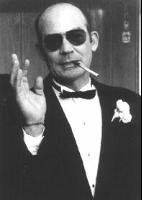 I am a Hunter S. Thompson fan. He's definitely among my five favorite authors of all time. I came across these two comments the other day from Dr. Thompson and thought I would share:
"I have no taste for either poverty or honest labour, so writing is the only recourse left for me."
and....
"I've always considered writing the most hateful kind of work. I suspect it's a bit like [censored, but begins with an "f"], which is only fun for amateurs. Old wh*res don't do much giggling."
Two somewhat competing sentiments, but some days they both fit.
As mentioned, HST is one of my favorites five. The others? Milan Kundera, Dom DeLillo, and Charles Bukowski round up the top four. Fifth place is a dead heat between Kurt Vonnegut, John Fante and a few "academic types" like Herbert Marcuse and Michel Foucault.
Gee, blogs are supposed to be sort of interactive, right? How about commenting with a few of your favorites?
 A few weeks ago, I mentioned completion of a new ebook ("Front Page News") about how to write effective press releases. Through a combination of routes, I was able to quickly sell enough copies to make the venture tolerably successful. Sales have slowed, but I am still logging an occasional customer--even after offering it free to all Content Done Better Blog readers on "100th Post Day."
This ebook is unlike many others in that it doesn't contain any advertisements or affiliate links. It's just a handy little straight guide to writing press releases that work.
When the idea for the ebook first crossed my mind, I commented that I might be better off spending my time aggressively marketing my ability to write press releases instead of showing others the process and directives I use. It's beginning to look like I killed two birds with one stone.
In the last week, I have completed several paying press release gigs and have booked more. The volume of press release work snagged during the last week exceeds usual levels by a huge margin. Only one of the buyers is a previous client. The ebook has seemingly positioned me as a reliable and trustworthy source for quality press releases.
I know that some of the clients came to me as a byproduct of having read the ebook's sales page, although they didn't buy a copy of the ebook (even at it's low introductory price of $14.95). At least one other came via word of mouth thanks to someone who knew about "Front Page News." I am not sure about the others, but the change in press release work volume leads me to believe that something more than strange coincidence is at play.
I mention this because I think it clearly demonstrates the value of developing "name recognition" and an expert standing in one's field as a means by which to garner additional business. In my case, I had a goal of selling enough ebooks to justify the time invested. I have basically managed that, but I have also reaped a nice reward by virtue of having written the book in the first place.
It's "inadvertent marketing," I guess, but it sure does seem to be working.
 This post was motivated by observations from one writer at her blog and by comments made in a writer's forum on the same topic. The issue? How can a freelance content writer maintain a consistent workload?
For most freelancers, writing for the web seems to be a "feast or famine" proposition. Either they have too much work to do and feel insanely pressured, or they are staring at a blank calendar hoping for a job. It can be a maddening cycle and it's one that has undoubtedly led several people to quite the industry.
I'm lucky, I guess. I always seem to have enough work to keep me mildly nervous at all times. Sure, some months are more packed than others, but I feel as though I can count on a consistent and acceptable base level of assignments monthly.
I don't claim to have all the secrets to staying busy, but I do have some opinions and ideas... If you are interested, here are ten of them...
(1) Quality keeps you busy. If you produce good work, you will get more repeaters and more word-of-mouth business.
(2) Customer service staves off famine. People like to work with those who treat them well.
(3) Flexibility pays. If you are an article writer, that's great. However, if you can diversify your skills to successful manage other content needs, your risk of being underbooked disappears.
(4) Being a generalist helps. If you like to work within a particular niche, you will experience wilder shifts of workload. If you are willing to research and tackle new subjects, however, your options multiply.
(5) Working your list produces results. If my schedule for the next month is looking a little thin, I will start contacting past clients in groups of five to ten, reminding them of my existence and seeing if they have anything in the works with which they could use a hand. It works.
(6) Self-promotion helps end the cycle. If your primary strategy is to hold tight and wait for bid job boards to come your way, the risk of a down time is probably high. Spending some time getting your name and skills in front of potential clients pays dividends. Blog daily. Write articles. Email potential clients. If you go to the mountain often enough, it will eventually come to you.
(7) Specials bring business. Large auto-makers give cash-back bonuses or offer employee pricing discounts. Shopping malls have sidewalk sales. Grocery stores offer weekend specials. Sometimes a good special offer can fill a schedule fast.
(8) The picky risk hunger. Sometimes you might have to break price a little. Sometimes you might have to take a dull topic or two (or seven). Sometimes you'll have to bite off a bigger chunk of pot roast than you are accustomed to chewing. Those who paint themselves into a very small "this is what I do" corner can find themselves with a small amount of work to do.
(9) Diversification makes a difference. Find a few other ways to put your online talents to work on the side. Maybe you can write and market your own ebooks. Perhaps you can launch a few low-maintenance, solid-earning Adsense blogs. Find a few residual earners to keep some extra income padding coming in every month.
(10) Improve. If you are on the feast/famine treadmill, you have to find a way to hop off. That might be by doing some of the things mentioned here. It might also requirement some improvements in your work or in how you run your business. Repetition is dull and promises nothing more than expected results, at best. Improvement, on the other hand, is a source of infinite possibility.
Personally, I think numbers 1 and 2 probably account for well over half of what keeps writers busy, but the other things are important, too.
I think that's what keeps me relatively busy. Do you have any other ideas/suggestions about how to keep a nice consistent workload as a freelance content writer? If so, please feel free to comment.
 It seems like every other day I am approached to write in exchange for a product or service instead of for money. Like most writers, I usually prefer cash over trade. Lately, however, I have received a few offers that were very inviting.
(1) I wrote a press release in exchange for a reasonably long run of premium ad space on a fairly well-trafficked site. The site in questions didn't really match with any of my projects, so I had to build a small affiliate and Adsense based page and a banner for it. The building process took me about three hours top to bottom. The press release required a bit of correspondence and then the associated writing work. Under normal circumstances, I wouldn't dream of taking a deal like that, but I really liked the site's niche and the potential traffic levels.
This trade was completed about twenty-four hours ago. So far, it has made me about two bucks. If it continues at at least that pace for the full seven weeks of my ad's run, it will have been a decent deal. If I factor in the mini-site I built for my end of this barter and its potential to produce some revenue on an ongoing basis after the ad run expires, it looks even better. Plus, the whole thing was a lot of fun.
(2) I wrote a brief solo ad in exchange for free access to a membership site. The site itself is nice and although I wouldn't have paid full price for it (I am a writer first and am not prone to over-investing in my "side" pursuits), it does offer some valuable material and tools. My membership is lifelong, and I would say that the break even point for me will be July, based on my need/interest level in the materials there. Anything after that is gravy.
I mention this, because I think writers too often turn down barter deals even when they might be a decent proposition. Most of us are thinking about immediate cash flow, and barter arrangements just don't provide that quick bounce in the PayPal account.
I will agree to a barter proposition when the end result of the deal puts me "money ahead" within three months. That means the value of the product/service I receive should allow me to secure earnings or savings equal to or greater than the rack price of the writing I do.
Three months may seem short-sighted, but successful internet-based business strategies can often have a short half-life. Additionally, I still have enough of a preference for cash deals that I find it hard to stretch out my possible gain any longer than around one hundred days.
In the case of the press release, the earnings spurred by the trade should cover the value of my work within one hundred days (far less, I hope). In the case of the solo ad, I believe the materials at the membership site will make me as much as I would have charged for the add within three months. Even if it doesn't, I would have been willing to pay for access at a reduced rate that makes the deal reasonable within that time frame.
Making that strategy work can be tricking. It requires some projection and a bit of guesswork. Certainly not a perfect science. More often than not, however, I find that trades can work to everyone's benefit if they are properly negotiated.
 By now, almost everyone with an interest in making sure his or her content (or content to be purchased) is original knows about Copyscape. Googling sample portions of text can also help uncover acts of plagiarism. I learned about an interesting new option to check for originality. It's designed for educators and is called Turnitin.
Here's how it works: Turnitin checks submitted student papers against the net, all other papers submitted to turn it in and an extensive electronic database of other resources, papers, etc. It then gives the teacher an annotated report highlight possible transgressions and final "originality"score.
Turnitin is bundled with some other educator resources like an online grading tool. It's an interesting system and you might want to take alook at their product tour.
It seems to me as if something like Turnitin will eventually be widely available to the non-academic community. Copyscape is great, but it has some limitations that a solution like Turnitin can solve by adding other non-web digitized resources to the process. The final report the program produces looks like a great proof when one claims content misappropriation.
My bet: Look for a pay-per-use version of a more generalized Turnitin-style system in the near future. As content originality continues to increase in importance along with incidents of stolen text, I think something like that would find a substantial audience.
 I came across this comment at John Dilbeck and Friends, in the context of a promotion including some Private Label Rights articles, about which the author had some reservations:
"I don't think it is right to put your name on articles you did not write, whether they are bought from PLR collections, reworked from the public domain, or written by a paid ghostwriter. I think it can damage your credibility and reputation and I think less of people - even well-known "gurus" - who represent themselves as the authors of articles, reports, and books they did not write."
I thought this was interesting grist for the Content Done Better Blog mill. I think (and I may be extrapolating a bit) that the comment raises two distinct concerns. The first has to do with whether or not the practice is ethically appropriate (is it "right?"). The second involves whether or not the use ghostwritten materials is always pragmatic.
I am going deal with the second issue first... The risk of presenting ghostwritten material as your own can be carefully managed, if not eliminated, by (a) choosing the correct author and (b) reviewing the material. Neither of those are necessary slam-dunk easy, but they are possible and they do work to protect one from pragmatic problems associated with the use of ghostwritten content.
Now, onto the meatier questions of the ethics of ghostwriting. I am definitely not the first person to address this matter and I doubt my opinion is earth-shattering, but I begin with the basic assumption that what we create is ours to do with what we would like (within the confines of the law, of course). I create an article. That article is mine. I can print it out and hang it on the refrigerator. I can use it as a blog entry. I can get it published in the New Yorker. I can sell it to you.
If I sell it to you, I can sell you the use of the article (exclusively or non-exclusively). I can place conditions on that sale. We can contract for whatever we'd like. Along with the freedom to dispose of my property is my right to sell it without any subsequent claim of authorship. You can buy it and own it outright. You can call it yours and put your name right on the top of it, if you'd like. Did you write it? No. But you purchased its authorship. I relinquished that in consideration of some sort of payment.
That is, from an economic and contractual standpoint, how I feel about it. But I am not sure that really gets to the meat of whether or not it is right. That's a bit more complicated.
Let's see what some other people think:
When asked "what are the ethics of ghostwriting?" Sacario, who pens lyrics for other hip-hop artists said, "There are not real ethics. You can do whatever your want to do. My style is different. When I sit down, I really write for that artist. Everyone alsways asks me to tell them who I write for, but I can't do that. That's my ethics."
So, that's one end of the spectrum. The often uncredited rap lyricist doesn't seem to see an ethical problem. Let's check out what someone we might think of as his polar opposite has to say. Let's go from the young African-American hip-hop writer to an old white University of Chicago Law School Professor, Richard Posner.
Posner, while discussing so-called managed books, states, "So the question...is whether failure to disclose that most of the actual writing was done by persons other than the nominal author misleads reader to their detriment. That depends mainly on the conventions, and hence expectations, of a particular field. A professional historian who 'authored' a managed book without disclosure of that fact would be committing a fraud because his fellow historians would think he'd written it himself. At the opposite extreme, few lawyers care whether a judicial opinion is written by a law clerk or by the judge, provided they think it's the judge's decision (the bottom line, the outcome), which it almost always is."
Posner goes on to discuss how contexts and expectations are often informed by culture, as well as by subject matter.
I think that if you put Sacario and Posner together, you have a very interesting mix. The ghostwriter takes the job and does what the client wants. The client is responsible for the use of the material and should make his or her decision based on the expectations and conventions of his or her field.
That might be passing the buck, but I think it makes sense. We, as ghostwriters, should not be placed in a situation where we must babysit our clients and their choices.
That wraps it pretty tidily, huh? As a writer I can just take the orders and produce the content and anything beyond that is not my problem.
Unfortunately, things tend to be a bit more complex. I have a personal sense of right and wrong. There are some topics I will not write about. No matter how much you pay me, I won't write sales copy for hate groups, for instance. Likewise, I would probably be reluctant to take a job in which I was writing something if I knew (or had a reasonable suspicion) that would be used improperly.
I think this is why most freelance writers would never think of writing term papers for college kids--they have a solid notion that the work is going to be used to perpetrate academic fraud. Of course, that is an egregious example, but the same principle does apply. I would probably pass on some gigs if I felt there was a strong likelihood that my work was being commissioned for an inappropriate purpose.
The alternative to doing a little self-policing is to become a gun manufacturer. You know, you can't blame us for gun crimes--we just make 'em, someone else shoots 'em. It's a true argument, in a sense, but its truth is only whole if it exists in an uninformed context.
So, getting back to Dilbeck (who probably wasn't that interested in all of this when the words "I don't think it's right" hit that blog)...
It is my belief that in most situations ghostwriting (as it is applied to writing web content) is perfectly appropriate and that buyers/clients should and can comfortably put their name right under the title without fear that they are engaging in wrongdoing. Again, that assumes a quality author choice and a review of the materials. However, if that individual is passing off that work as his or her own within a particular discipline or area where complete originality is expected, they should probably rethink their strategy.
 This marks the 100th post here at the Content Done Better Blog. Feel free to send cards, email congratulatory sentiments, or leave your heartfelt comment about this very memorable milestone!
To mark the occasion, I am GIVING AWAY (see how I capitalized that, to scream over the applause?) a copy of my guide to writing press releases. It's currently selling for $14.95, but it's completely FREE for Content Done Better Blog readers today only. You can download it here. You may now celebrate.
Okay, now that I have cleaned up the empty plastic champagne glasses and discarded party hats from the 100th post party, here are a few project updates for those who are even vaguely curious about what is happening at Content Done Better.
(1) The Google Duplicate Content filter project is underway. I am in the research phase and will begin writing a report about the filter, its nature and its consequences in the next few weeks. I have decided that I will make it available free to all CDB Blog readers, so be sure to check back if you are interested.
(2) The Freelance Content Writers "Cooperative" is still on the horizon. I just heard back from the first designer on my list and the price quote I received was stomach-churning. There is going to be some adjustment necessary in terms of features and design to make it feasible, but I do believe it can work. Additionally, I am wondering if the plan may be successfully dovetailed with a growing movement to create a web content writers' "trade association." Diane Penna, who has been walking point on this project with me, has already secured a viable domain name and will probably have some excellent input/instruction as we progress with this.
(3) Content Done Better is officially in the audio business. Yesterday, I added a brief audio-related page to the CDB website in recognition of the fact I am booking more audio jobs and more text jobs with an audio component. Speaking of audio, the CDB podcast "Three Minutes on Content" should be hitting the virtual airways next week. You can hear a sample here.
(4) Writer Wrangler is proving to be a great way to post freelance content jobs and to find some excellent partner writers to help with Content Done Better projects. I have listed five jobs there so far, and all have been completed on-time and to my satisfaction. I think the forum has real potential as a writing community and the overall mood and structure of WrWr seems pretty friendly. If you write and aren't a member, take a look and visit the forum.
(5) I have three potentially massive undertakings that are just on the verge of going public. One involves the audio component of Content Done Better and the other two are good old-fashioned writing efforts. Stay tuned...
Oh, and I have been told that I don't use this blog as a marketing tool as strongly as I should. Apparently, a few people think I should keep reminding readers that if they need a freelance content writer for any project, they should contact me via email at cdbrack@gmail.com, use the form on the right of this page, or stop by the Content Done Better website.
You need content. I write content.
How's that for heavy-handed marketing?
Thanks again for reading often enough to convince me to write 100 posts. I am sure the next 100 will come just as easily.
